





If Trump wants to smash Mexican cartels, he's got history and law on his side


President Trump has constitutional authority to strike drug cartels in Mexico under precedents set by Jefferson and Wilson against foreign threats.
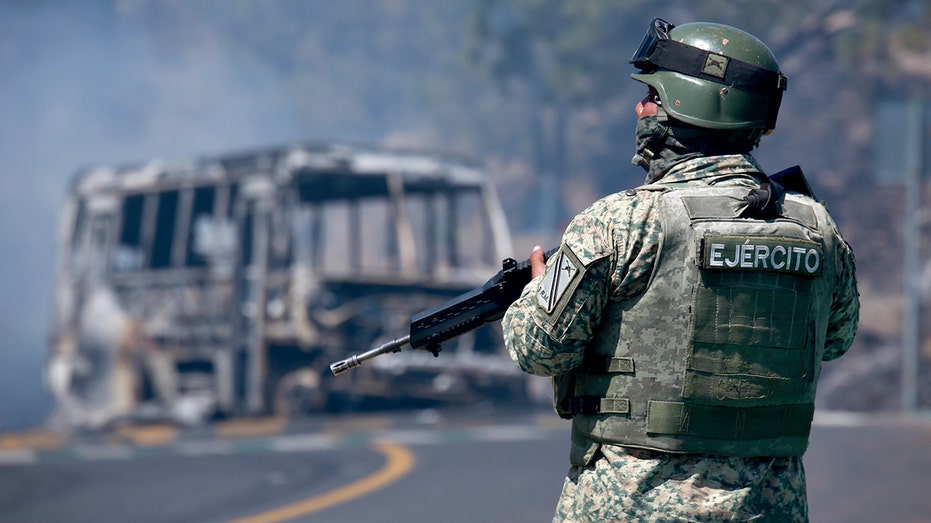
With Puerto Vallarta and the state of Jalisco under siege from the cartels, American policymakers need to know that President Donald Trump would be on strong legal ground if he chooses to hit the cartels in Mexico or anywhere in the world.
Over the last four decades, the drug cartels have transported tens of thousands of military-age men over our borders, many of them carrying weapons of mass destruction like fentanyl or carfentanil. This isn’t "migration." It’s an invasion, and, under the Constitution, the president not only has the authority, but the duty to act.
Though the drug cartels are non-state actors, they effectively control roughly one-third of Mexican territory, exerting quasi-sovereignty by extracting "taxes," controlling the movement of people, and intimidating and extorting government into doing their will.
Trump has done what no president in decades could do: he secured the southern border and stopped the massive influx of illegal aliens and dangerous drugs. But is America required to stand back and wait for criminals to cross our borders in order to defend itself? Of course not. There is ample precedent for presidents using the military to take on non-state actors abroad who threatened the lives and livelihoods of Americans — even without congressional authorization.
MADURO-BACKED TDA GANG’S EXPANSION INTO US CITIES EMERGES AS KEY FOCUS OF SWEEPING DOJ INDICTMENT
Shortly after taking office in 1801, President Thomas Jefferson famously sent the Marines "to the shores of Tripoli" to punish pirates who for years had harassed American merchant ships and demanded tribute payments. Congress was not in session, but Jefferson neither waited for authorization nor called them into session. Despite having a relatively small navy for the time, the new president sent a squadron to the Mediterranean with orders to sink the pirates if necessary. In August 1801, the squadron sank a ship off the coast of Malta without congressional authorization. In February 1802, Congress passed an authorization of force — not a declaration of war.
On March 9, 1916, the outlaw Pancho Villa’s raiders killed three American citizens and then crossed the border to attack Columbus, New Mexico, killing 10 American soldiers, robbing American businesses and killing eight more civilians. Maj. Frank Tompkins’s men pursued the raiders 15 miles across the Mexican border, killing 100 of them and capturing 30. Villa’s men had previously executed a train car full of American engineers who were on their way to work in Mexico’s mines. The Mexican government continually proved unable to bring Villa and his men to justice.
President Woodrow Wilson called an emergency cabinet meeting on March 10. Wilson decided to send the Army into Northern Mexico, citing an 1882 treaty that allowed "hot pursuit" over the border. Wilson sent 4,800 soldiers into Mexico under General John J. "Black Jack" Pershing on a "punitive expedition" to track down Villa and his men. Congress showed their approval with a concurrent resolution two days after the fact. The Mexican government protested and even fought back against the Army, but ultimately backed down in the face of American strength.
JONATHAN TURLEY: MADURO OPERATION WAS LEGAL, BUT TRUMP MAKES IT COMPLICATED
Drug cartels have killed far more Americans than either the Barbary Pirates or Pancho Villa ever did. As the DEA has said repeatedly, nearly all of the drugs killing Americans today were trafficked over our southern border.
Some liberals and libertarians would likely object that attacking the cartels in Mexico or outside our borders would violate the War Powers Act, which Congress passed over President Nixon’s veto in 1973. But even if a court upheld the War Powers Act on its merits — which has still never happened — the law merely requires that the president notify Congress of an attack within 48 hours and limits an attack to 90 days without congressional authorization.
CLICK HERE FOR MORE FOX NEWS OPINION
Since the WPA’s passage, presidents of both parties have conducted military operations all over the world without congressional authorization — from Haiti to Libya to Bosnia.
Declarations of war have been extremely rare in our history: the last was in 1942. The Founders intentionally gave the president broad and fulsome powers to conduct military operations after the sclerotic Articles of Confederation proved unable to respond to Shay’s Rebellion and the British refusal to remove troops from newly independent American territory. Presidents must be able to act quickly and decisively to protect Americans from national security threats, and the Founders gave them the tools to do just that.
After President Trump took office last January, the military began Operation Southern Spear, which has involved direct attacks on drug smuggling boats from Venezuela. Like Jefferson’s squadron against the Barbary Pirates or Wilson’s "punitive expedition" against Pancho Villa, the Trump administration isn’t waiting until the criminals cross our border — nor should they.
The cartels have been enriching themselves for decades by getting Americans addicted to deadly drugs, bringing tens of thousands of military-age men into our country and costing hundreds of thousands of American lives. Whether the cartels stand on American soil or on foreign soil, the president stands on solid legal ground in bringing them to justice.
The post If Trump wants to smash Mexican cartels, he's got history and law on his side appeared first on FOX News Media