




Top Haitian leader reveals which US policy the country would be 'helpless' without: 'Give them money'
-
Entertainment, Immigration
-
-
4 mins
-
FOX News Media
-


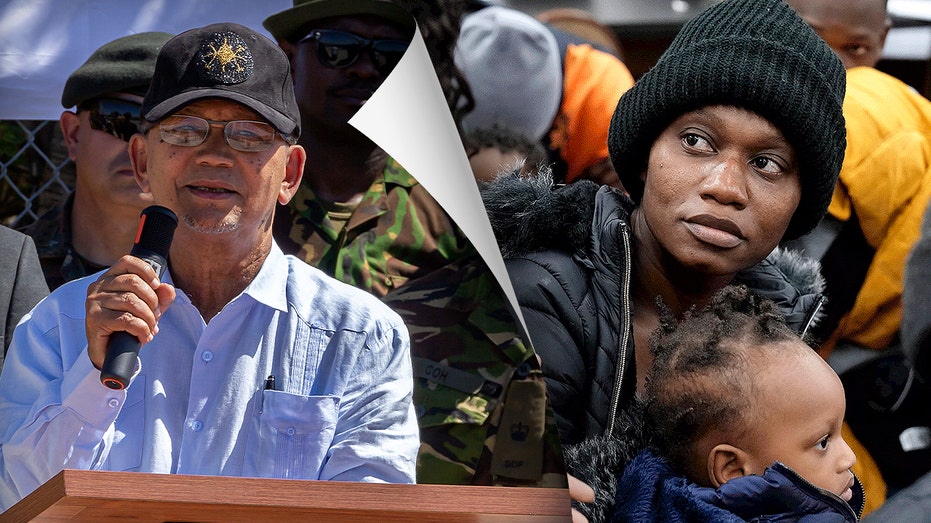
Leslie Voltaire, a member of Haiti's transitional council, says the end of Haitian's temporary protected status by the United States could lead to major economic and social disaster.
One of the nine current leaders of Haiti's transitional government admitted to Fox News Digital his country is "helpless" to handle the return of its citizens, noting that Haiti relies on billions of dollars generated by U.S., Canadian and French-based migrants to keep its economy going.
Leslie Voltaire, a member of the nine-member transitional council leading Haiti ahead of scheduled elections later this year, described a state of total dependency on temporary protected status (TPS) that has now spanned more than 15 years and which President Donald Trump is trying to end.
Voltaire warned that a sudden termination of TPS would trigger an immediate crisis because the nation lacks the economic infrastructure to reabsorb as many as 400,000 repatriated citizens from the United States.
"We think that we are helpless if another country is sending back our compatriots," Voltaire told Fox News Digital. "We cannot do anything about it – just accommodate them, give them money to go back to their provinces and to their cities, help them with food. But it's very painful due to the small budget that we have in the government."
STATE DEPARTMENT ISSUES SECURITY ALERT AMID 'HEAVY GUNFIRE' NEAR US EMBASSY IN HAITI
Trump tried to end Haiti's long-standing TPS status during his first administration, but, similar to today, federal judges stepped in to block the move.
In November, the Department of Homeland Security (DHS) published a notice indicating that Haiti's temporary status would not be renewed this month, but in a subsequent 11th-hour ruling earlier this week, U.S. District Judge Ana Reyes issued a preliminary injunction blocking the Trump administration from ending Haiti’s TPS status.
Reyes argued the move was likely motivated by "hostility to non-white immigrants" as opposed to an objective view of the ongoing situation in Haiti.
Shortly before Fox News Digital spoke with Voltaire Thursday evening, three U.S. warships arrived off the coast of Haiti ahead of the country's Feb. 7 deadline for the council to transition power to a soon-to-be elected leader or leaders. In addition to the U.S. ramping up its presence, the United Nations recently approved, with U.S. support, the deployment of a new Gang Suppression Task Force to Haiti to help with the ongoing violence there.
When asked for specific metrics on when Haiti might be stable enough to no longer require its TPS status, Voltaire did not point to anything concrete, like a certain number of police officers, territory controlled or national GDP. Rather, Voltaire said Haiti needs more time, more investment and greater security before the country can be considered stable enough to take back hundreds of thousands of its people.
"The problem of security in Haiti is mainly to have jobs," Voltaire told Fox News Digital. "There are no jobs because there is no investment right now. There is no investment because there is insecurity. And also we have to provide services to the population, so, there is a huge need of cash, of resources – financial resources. … If they come with 400,000 people, that would be a huge problem."
Voltaire conceded the U.S. economy and migrant labor — pointing out Haitians living in the U.S., Canada and France bring $3 to $4 billion per year into Haiti through remittances — could be described as a "crutch," indicating that around 85% of the country's "professional" class lives abroad.
Voltaire noted that Haitian leadership was "pleading" with U.S. leadership to give it a break on tariffs, something Voltaire thinks could improve his country's economic situation.
"We don't have an economy that has the capacity to produce the kind of dollars that [migrant workers] are generating," Voltaire lamented.
While admitting his nation is propped up by migrant labor from the U.S., as well as France and Canada, Voltaire simultaneously pointed the finger at the United States for the very poverty that necessitates the aid Haiti needs.
Voltaire argued that a 19-year U.S. military "occupation" in the early 20th century "depleted" Haiti's middle class by turning the country into a pool of cheap labor for neighboring sugarcane producers.
"I think one of the historic problems is that when the U.S. occupied Haiti between 1915 and 1934, they chose to use the Dominican Republic and Cuba as the sugarcane producers," Voltaire said when asked about why the neighboring Dominican Republic has not dealt with some of the same instability as Haiti.
"And Haiti, because it was densely populated, was treated as the labor for those countries. This is why we have like half a million Haitians in the Domincan Republic, and the same in Cuba … and we have been depleted."
Voltaire also cited the U.S. favoring the "dictatorship" of the former president of Haiti between 1957 and 1971, Francois Duvalier, for the dire circumstances in Haiti and why the Domincan Republic has fared differently.
"The U.S. was favoring the dictatorship of Duvalier, which was bad with the Tonton Macoute and which did not have the investment that we hoped we would have when Kennedy launched the Alliance for the Progress. We were not part of it. And we have been under a dictatorship. And then when the dictatorship disappeared, there was a dismantlement of the Haitian state that we have to reconsolidate," Voltaire pointed out.
Voltaire cited this history as a reason why 85% of its professional class, like university professors, artists and skilled technicians live outside of Haiti. And he mused that "maybe it's a good thing" to begin repatriating Haitians back to their home country. But he reiterated that economic and political development must continue for that to happen.
The post Top Haitian leader reveals which US policy the country would be 'helpless' without: 'Give them money' appeared first on FOX News Media