









Vietnam Changes Document Legalisation Rules for Indian Travellers From September 2026 With New Apostille System
-
Travel
-
-
7 mins
-
Travel and Tour World
-
Samadrita Mukherjee
-


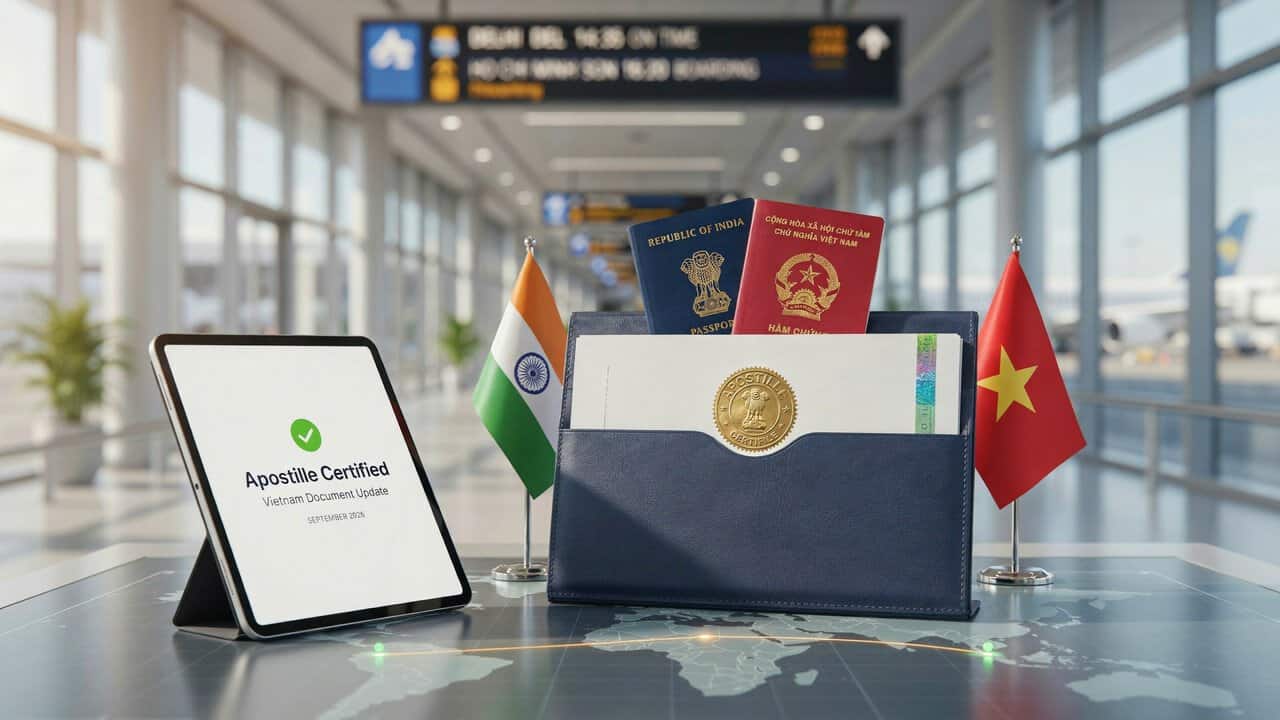
Vietnam updates document legalisation rules for Indian travellers from September 11, 2026, introducing Apostille certification for eligible documents.
There has been a significant administrative update in the process of authentication of the documents of Indian travellers to Vietnam. Since September 11, 2026, there has been a new process for Indian Travellers, involving the issuance of an apostille to the required documents in accordance with the Vietnam document legalisation rules for Indian travellers.
This process is crucial for Indian tourists, businesspersons, students, employees or anyone else who needs to authenticate certain documents in Vietnam. These documents include various educational and personal records. It should be noted that the documents requiring Apostille under the Vietnam document legalisation rules for Indian travellers will no longer have to undergo separate consular legalisation in the Embassy of Vietnam in India.
This system corresponds to the 1961 Hague Apostille Convention, the purpose of which is the international legalisation of documents. It should be borne in mind that although the new system simplifies the process of document authentication, one needs to make sure which documents he/she has to undergo consular legalisation.
Why Are Vietnam’s New Document Rules Important for Indian Travellers?
The new document authentication process changes how Indian citizens prepare paperwork before using official documents in Vietnam. While normal tourists visiting Vietnam for holidays will generally not be affected, travellers involved in education, employment, business, family matters or long-term stays need to understand the updated requirements.
Previously, applicants often had to complete additional legalisation steps through diplomatic channels. The introduction of the Apostille system creates a more standardised process for eligible documents and removes the need for embassy legalisation in cases covered by the new rules.
For Indian travellers, the biggest impact is that document preparation must now happen before submission in Vietnam. Missing certification, incorrect translations or misunderstanding document categories could create delays in official procedures.
Major Changes Indian Applicants Need to Understand Before Using Documents in Vietnam
| Previous Document Process | New Apostille-Based Process From September 11, 2026 |
|---|---|
| Documents followed traditional consular legalisation procedures | Eligible documents require Apostille certification |
| Embassy involvement could be required after local authentication | Embassy legalisation is removed for covered documents |
| Applicants followed multiple verification stages | Applicants complete Apostille certification through authorised Indian channels |
| Process could involve additional administrative steps | Process becomes more streamlined for eligible documents |
The change creates a simpler pathway for eligible documents but also places greater responsibility on travellers to identify the correct procedure before submitting paperwork.
What Is the New Apostille Requirement Introduced by Vietnam?
An Apostille is an official certificate attached to a public document to confirm the authenticity of the signature, seal or stamp placed on that document by a recognised authority.
The Apostille does not verify whether the information written inside a document is correct. Instead, it confirms that the document has been issued or certified by the appropriate authority.
The system operates under the Hague Convention of 1961, which was created to remove complicated legalisation procedures for public documents used internationally.
Key Facts About Apostille Certification for Indian Documents
| Category | Details |
|---|---|
| Main purpose | Authentication of official signatures, seals and stamps |
| Applies to | Eligible public documents used overseas |
| Does it verify document content? | No, it only confirms authenticity of official certification |
| International agreement | Hague Convention of 1961 |
| Main advantage | Reduces additional embassy legalisation requirements |
For Indian travellers, the Apostille becomes an important document preparation step when official Indian records need to be recognised in Vietnam.
Which Indian Travellers Will Be Affected by Vietnam’s Document Update?
The updated requirement mainly affects Indian citizens who need to present official documents to Vietnamese authorities or institutions.
Travellers visiting Vietnam for tourism usually do not need Apostille certification because they are not submitting public documents for administrative purposes. However, people travelling for study, work, business or family-related reasons may need to complete the new process.
Travellers Who Should Review Apostille Requirements Before Departure
| Traveller Group | Documents That May Require Authentication |
|---|---|
| Indian students | Degree certificates, academic records and educational documents |
| Professionals and workers | Employment papers, qualification certificates and professional records |
| Families | Birth certificates, marriage certificates and civil documents |
| Businesses | Corporate records, agreements and official company documents |
| Long-term residents | Personal and administrative paperwork |
The exact requirement depends on the purpose of the document submission and the rules applied by the Vietnamese authority receiving the document.
How Can Indian Travellers Complete the New Vietnam Document Process?
Indian applicants should begin document preparation before travelling to Vietnam if their visit requires official paperwork. The updated system involves several important steps, including document verification, Apostille certification and translation requirements.
Travellers should avoid waiting until the final stage because completing authentication procedures may require additional time.
Steps Required to Prepare Indian Documents for Vietnam Submission
- Identify the document requirement
Travellers should first confirm which documents are needed for their specific purpose in Vietnam. - Check Apostille eligibility
Applicants must confirm whether their document qualifies for Apostille certification or whether another legalisation process applies. - Obtain Apostille certification
Eligible Indian public documents must receive an Apostille from the authorised Indian authority. - Complete Vietnamese translation requirements
Documents that are not written in Vietnamese must include a notarised or certified Vietnamese translation. - Confirm exceptions
Some documents may still require consular legalisation depending on their category.
| Process Stage | Traveller Action | Purpose |
|---|---|---|
| Document review | Identify required paperwork | Ensures correct documents are prepared |
| Eligibility check | Confirm Apostille requirement | Prevents incorrect submissions |
| Certification | Obtain Apostille | Provides international authentication |
| Translation | Arrange Vietnamese translation if required | Allows Vietnamese authorities to review documents |
| Final verification | Check exceptions | Avoids delays during submission |
Following each step carefully will help Indian applicants complete their Vietnam-related procedures more efficiently.
What Should Indian Travellers Know Before Submitting Documents in Vietnam?
The new rule focuses on official documents rather than normal travel requirements. Indian travellers visiting Vietnam for sightseeing, holidays and short visits generally will not need Apostille-certified paperwork.
However, travellers planning official activities should understand the difference between ordinary travel documents and administrative documents.
Students applying to Vietnamese educational institutions, professionals beginning employment and families completing legal procedures should prepare their paperwork well before their planned travel date.
Essential Checks Indian Applicants Must Complete Before Travel
- Eligibility: Confirm whether your document falls under the Apostille system.
- Purpose: Check why the document is being submitted and which authority will receive it.
- Translation: Arrange certified Vietnamese translation if required.
- Timing: Complete authentication before application deadlines.
- Verification: Confirm requirements with relevant authorities before submission.
Careful preparation will reduce the possibility of delays and help travellers complete official procedures smoothly after arriving in Vietnam.
Why Does Vietnam’s Apostille System Matter for Future India–Vietnam Travel?
The introduction of the Apostille system reflects the growing importance of smoother international mobility between countries. As India–Vietnam connections expand through education, employment, investment and business cooperation, efficient document recognition becomes increasingly important.
For Indian travellers, the updated system could reduce paperwork complexity for eligible documents by removing additional embassy legalisation procedures.
How Easier Document Recognition Could Support Cross-Border Mobility
- Supports Indian students preparing documents for Vietnamese universities and institutions.
- Helps professionals complete employment-related procedures more efficiently.
- Simplifies business documentation between Indian and Vietnamese organisations.
- Creates clearer procedures for families handling official paperwork.
The change aligns Vietnam’s document authentication system with international standards and may support easier movement for people involved in long-term activities between both countries.
How Is Apostille Different From Traditional Document Legalisation?
Although both Apostille certification and traditional legalisation confirm the authenticity of official documents, they follow different procedures.
The Apostille system is designed for countries participating in the Hague Convention, allowing documents to be recognised without additional embassy legalisation.
Main Differences Between Apostille Certification and Embassy Legalisation
| Apostille Certification | Traditional Consular Legalisation |
|---|---|
| Based on Hague Convention procedures | Based on diplomatic authentication procedures |
| Requires certification from authorised authority | May require multiple government and embassy steps |
| Removes embassy legalisation for eligible documents | Embassy verification may still be necessary |
| Designed to simplify international document acceptance | Often involves longer administrative processes |
Understanding this difference is essential for Indian applicants because choosing the wrong procedure could delay document acceptance.
What Travellers Should Know Before Booking or Travelling to Vietnam
Indian travellers should review document requirements early if their Vietnam trip involves official activities. Preparing documents before departure can prevent delays and avoid last-minute administrative problems.
The new process does not change Vietnam’s tourism experience for ordinary visitors, but it creates a new checklist for travellers who need official documents recognised.
Important Requirements Before Submitting Documents
- Confirm whether your document requires Apostille certification.
- Keep original documents ready for authentication.
- Complete translation requirements before submission.
- Allow sufficient time for certification procedures.
- Check updated guidance from official authorities.
A clear understanding of the process will help Indian travellers manage their Vietnam-related paperwork more effectively.
Frequently Asked Questions About Vietnam’s New Document Rules
Do Indian tourists need Apostille certification for Vietnam travel?
No. Indian tourists visiting Vietnam for holidays generally do not need Apostille certification because they usually do not submit public documents to Vietnamese authorities.
Which Indian documents may require Apostille certification?
Educational certificates, civil documents, professional records and other eligible public documents may require Apostille certification depending on their purpose.
Does Apostille replace Vietnamese translation requirements?
No. Documents that are not written in Vietnamese may still require a notarised or certified Vietnamese translation.
Are all Indian documents covered by Vietnam’s new rule?
No. Only eligible public documents are covered. Some documents may continue to require consular legalisation.
When did Vietnam introduce the Apostille requirement?
The new Apostille-based document authentication system began on September 11, 2026.
Closing Update
The new Vietnamese document legalisation policy signifies a significant step for Indians as far as their travel documents are concerned. This is because of the fact that the introduction of the Apostille system makes it easier to have some documents legalised for use in Vietnam.
Students, workers, families and businesses in India must take the following steps in advance to have their documents in order when they submit them to Vietnam.
The most significant step to be taken by the travelers is to determine which kind of documents these are.
The post Vietnam Changes Document Legalisation Rules for Indian Travellers From September 2026 With New Apostille System appeared first on Travel and Tour World