





Thousands of Travelers Grounded Across the Middle East as Tensions Escalate, Emirates, Saudia, Etihad, British, KLM, Swiss, United, Delta, Air Canada and More Airlines Cancel 1802 Flights and Delay 397, Sparking Chaos in Dubai, Riyadh, Munich, Paris, Dall
-
Travel, Religion
-
-
4 mins
-
Travel and Tour World
-
Susmita Das
-


Middle East tensions disrupt global travel as 1802 flights are cancelled and 397 delayed, with over 9500 cancellations in four days across major hubs
Escalating geopolitical tensions across the Middle East have triggered widespread aviation disruption, grounding thousands of passengers and sending shockwaves through global travel networks. Major international carriers including Emirates, Saudia, Etihad Airways, British Airways, KLM, Swiss International Air Lines, United Airlines, Delta Air Lines and Air Canada have collectively cancelled 1,802 flights and delayed 397 more, creating operational chaos across key global hubs.
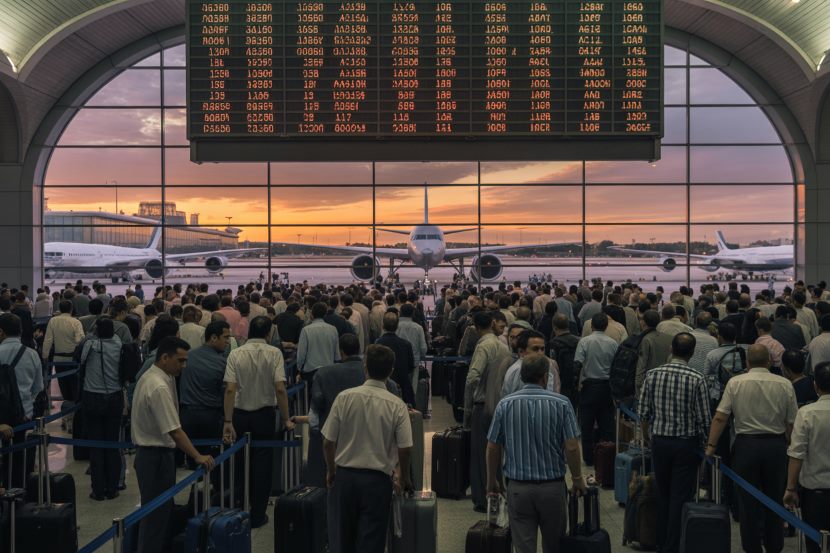
The disruption has stretched far beyond the Middle East, affecting major gateways in Dubai, Riyadh, Munich, Paris, Dallas, Chicago and other international cities. As airlines suspend routes, reroute aircraft, and adjust schedules due to airspace restrictions and safety considerations, passengers are facing missed connections, long airport queues, and uncertain travel timelines.
Dubai and the UAE at the Center of the Crisis
The heaviest impact has been recorded at Dubai International Airport, which alone reported 809 cancellations and 31 delays. As one of the world’s busiest transit airports connecting Europe, Asia, Africa, and North America, disruptions in Dubai have caused immediate ripple effects across long-haul networks.
Al Maktoum International Airport has also experienced cancellations and minor delays, further limiting operational flexibility within the emirate. Abu Dhabi International Airport recorded 100 cancellations and 25 delays, directly impacting Etihad’s operations, while Sharjah International Airport reported 20 cancellations and 10 delays.
With Dubai and Abu Dhabi serving as major global transfer hubs, cancellations have disrupted onward travel to Europe and North America, including flights bound for Munich, Paris, Dallas and Chicago.
Saudi Arabia’s Major Hubs Under Pressure
Saudi Arabia has also faced significant operational strain. King Abdulaziz International Airport in Jeddah recorded 74 cancellations and 115 delays, while King Khalid International Airport in Riyadh logged 69 cancellations and 110 delays.
In the Eastern Province, King Fahd International Airport saw 39 cancellations and 34 delays. Prince Mohammad bin Abdulaziz Airport in Medina registered 20 cancellations and 27 delays.
These airports are vital for business travel, domestic connections, and religious tourism, amplifying the disruption’s economic and social impact.
Qatar, Bahrain, Kuwait and Wider Regional Impact
Hamad International Airport in Doha reported 179 cancellations and 11 delays, affecting long-haul connectivity between Asia, Europe and North America.
Bahrain International Airport saw 143 cancellations, while Kuwait International Airport recorded 46 cancellations.
Beyond the Gulf, Ben Gurion International Airport experienced 145 cancellations and one delay. Queen Alia International Airport reported 68 cancellations and eight delays, while Baghdad International Airport logged 25 cancellations. Imam Khomeini International Airport recorded 10 cancellations and one delay.
The concentration of cancellations across interconnected air corridors has severely constrained regional mobility.
More Than 9,500 Cancellations in Four Days
The broader picture reveals an even more dramatic escalation. Across seven major Middle East airports — Dubai International, Hamad International, Abu Dhabi International, Sharjah International, Kuwait International, Bahrain International, and Al Maktoum International — total cancellations have now exceeded 9,500 flights since February 28.
The daily breakdown underscores the rapid intensification:
- February 28: Over 1,400 cancellations
- March 1: More than 3,400 cancellations
- March 2: Over 3,400 cancellations
- March 3: More than 1,300 cancellations
The sharp spike on March 1 and March 2 marked the peak of operational shutdowns as airlines responded to evolving airspace restrictions and safety assessments.
Global Ripple Effect Across Europe and North America
The disruption has not remained confined to the Middle East. European carriers such as British Airways, KLM and Swiss International Air Lines have adjusted Gulf-bound operations, affecting schedules in cities including Munich and Paris. Aircraft rotations between Europe and the Middle East have been interrupted, leading to delays across broader European networks.
In North America, United Airlines, Delta Air Lines and Air Canada have faced schedule changes on transcontinental routes linked to Gulf hubs. Flights connecting Dallas and Chicago to Middle Eastern destinations have been rescheduled or rerouted, affecting onward travel throughout the United States and Canada.
Because Gulf hubs serve as primary connection points for long-haul international traffic, disruptions there cascade across continents, influencing fleet availability and crew scheduling worldwide.
Why the Disruptions Are So Severe
Several overlapping factors are contributing to the scale of cancellations:
- Airspace closures and restricted corridors
- Safety-driven precautionary suspensions
- Aircraft displacement across international fleets
- Crew duty-time limitations and rotation challenges
- Heavy passenger volumes at major transit hubs
When major transfer airports experience hundreds or thousands of cancellations, airlines must restructure entire route networks, not just individual flights. The resulting domino effect spreads quickly throughout the global aviation system.
Passenger Impact and What to Expect
For travelers, the immediate impact has included long queues at service counters, difficulty securing alternative seats, and uncertainty around onward travel plans. Many passengers connecting through Dubai, Doha, or Riyadh have missed onward flights due to schedule instability.
Airlines are advising passengers to closely monitor flight status updates and confirm bookings before heading to the airport. Flexible change policies are being extended by several carriers as the situation continues to evolve.
While airlines are prioritizing safety and operational stability, the timeline for full recovery remains uncertain. If tensions persist or airspace restrictions expand, further cancellations may follow.
Conclusion
The cancellation of 1,802 flights and delay of 397 more reflects only a portion of a much larger aviation disruption that has already surpassed 9,500 cancellations across key Middle Eastern airports in just four days. The scale of the crisis demonstrates how deeply integrated global air travel has become — and how swiftly regional instability can disrupt worldwide mobility.
As airlines continue to monitor the evolving situation, travelers across Dubai, Riyadh, Munich, Paris, Dallas, Chicago and beyond are bracing for continued uncertainty. Until airspace restrictions ease and operational stability returns, the global aviation network remains in a fragile state, with passenger safety and schedule recovery at the forefront of airline priorities.
Source: Different airports and FlightAware
The post Thousands of Travelers Grounded Across the Middle East as Tensions Escalate, Emirates, Saudia, Etihad, British, KLM, Swiss, United, Delta, Air Canada and More Airlines Cancel 1802 Flights and Delay 397, Sparking Chaos in Dubai, Riyadh, Munich, Paris, Dall appeared first on Travel and Tour World