



Startling mystery revealed in centuries-old royal tombs at powerful queen's monastery
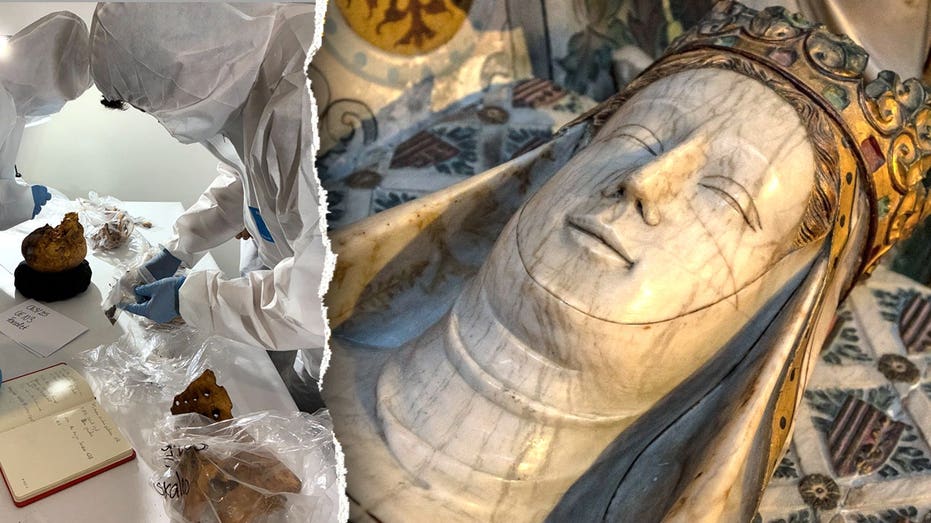


Several royal tombs at Pedralbes Monastery contained the wrong people, with 25 remains found in eight tombs and DNA testing planned through 2027.
When researchers in Barcelona recently opened centuries-old royal tombs, they uncovered a startling mystery: Several contained the wrong people.
The exhumations took place at the Royal Monastery of Santa Maria de Pedralbes in Barcelona, Spain, a nearly 700-year-old Gothic monastery founded by Queen Elisenda of Montcada.
The wife of King James II of Aragon, Elisenda, founded the monastery in 1326 — and to mark its 700th anniversary, researchers wrapped up a multidisciplinary investigation into its medieval tombs.
HIDDEN UNDERGROUND CHAMBER REVEALED BENEATH HOME OF LEGENDARY ROMAN EMPEROR
Local officials have now shared the first results of a three-year excavation and research project, which produced several unexpected discoveries.
They found that many of the remains did not belong to the people assigned to the tombs.
"One of the project's most significant findings is that the opening of several tombs showed that the identities historically assigned to them do not necessarily correspond with the remains found inside," the release noted, which was translated from Catalan.
"In the tomb of Artau de Foces, researchers found no male individual. Instead, they discovered the remains of five people: two adult women and three children."
The sheer number of skeletons found was surprising, said Enric Puga, communications officer for the Royal Monastery of Santa Maria de Pedralbes.
1,740-YEAR-OLD ROMAN COIN BEARING EMPEROR'S NAME FOUND AS ENGLAND RAIL DIG REVEALS CLUES
Puga told Fox News Digital that researchers were not expecting to find the remains of 25 people in eight tombs — and were even more surprised to find over 200 archaeological samples, including funerary offerings and preserved plants.
"The openings have shown re-openings and subsequent alterations, which means that we do not always find the person identified with the tomb," he said.
"This is the case of the tomb of Francesca Saportella, second abbess of the monastery, where at least nine individuals of late chronologies have been found, some with edge weapon wounds, as well as a female trunk mummified with fetal remains," added Puga.
"The abbess is not there, in any of the identified remains."
MYSTERY DEEPENS AFTER 2,700-YEAR-OLD BRONZE SWORD EMERGES STANDING UPRIGHT
He said it was "reassuring" to find that the wooden box preserving the queen's tomb dated to the medieval period and remained in excellent condition.
Researchers found that Queen Elisenda was buried in simple, modest clothing, despite being a queen — and that her remains showed health conditions commonly associated with old age.
"Thanks to archaeobotanical analysis, we have been able to identify several different funerary rites, with plants associated with body preparation, such as rosemary, but also floral offerings with a symbolic component," he added.
TEST YOURSELF WITH OUR LATEST LIFESTYLE QUIZ
"The subsequent reopening of some tombs gives us a lot of information about the funerary culture. ... Inside some tombs, some wrapped in bundles, we have found many objects from the daily life of the period."
CLICK HERE TO SIGN UP FOR OUR LIFESTYLE NEWSLETTER
Additional DNA testing is planned through 2027.
So far, researchers have recovered about 6% of Queen Elisenda's genome, allowing them to make preliminary estimates about some of her pigmentation traits, according to the project.
Puga added that all the research was done with the approval of the monastery's community of nuns.
CLICK HERE FOR MORE LIFESTYLE NEWS
"However, [Queen Elisenda's] final will [shall] always be honored, which stipulates that all remains studied must be returned to the monastery to be interred in the same location where they were originally buried," said Puga.
Overall, Puga said the results have provided "significant insights regarding the 14th century."
"Once all the samples have been analyzed, this information on the burials of a female power center will enable an understanding of medieval Catalan society," he said.
The post Startling mystery revealed in centuries-old royal tombs at powerful queen's monastery appeared first on FOX News Media