










Norway Reveals Europe’s Longest Winter Darkness and Brightest Summer Skies
-
Travel, Weather
-
-
7 mins
-
Travel and Tour World
-
Sneha Sarkar
-


Explore Europe’s darkest and most sunlit cities using official climate data including annual sunshine hours polar night periods and midnight sun seasons.
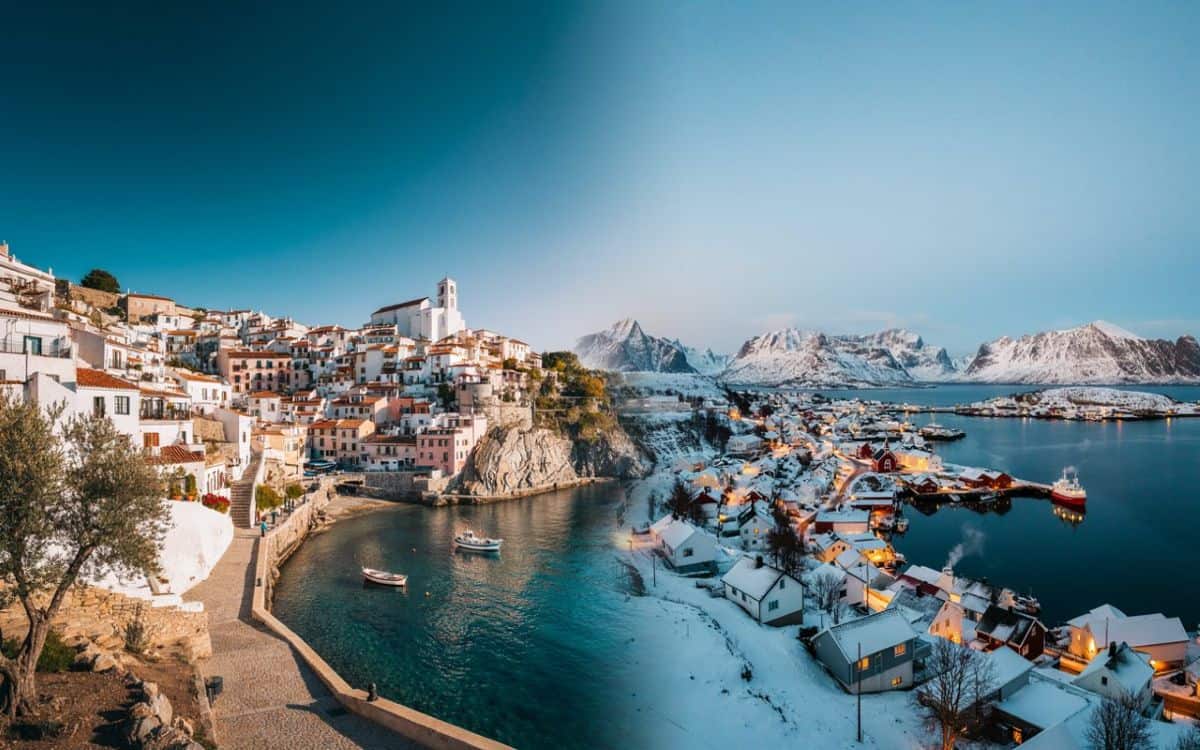
The Norway country shows the longest darkness in the winter and bright summer sky due to a fascinating Arctic cycle that alters how the visitors perceive the northern region. Winter sees the latitudes have no dawn, though there is some blue twilight that can paint the surroundings. However, once spring comes, the pattern changes in a matter of time. During the summer, the Norway country presents an entirely new view where the visitors will see brighter skies with longer daytime. This difference makes the northern edge of Europe attractive for the travelers looking to explore nature and photographing scenes.
Europe’s Light Map Is More Surprising Than It First Appears
Bright sunshine duration measures periods when direct sunlight is strong enough for weather equipment to record it. Daylight duration only measures the time between sunrise and sunset. Clouds can block the sun during a long day. This means a place may receive many hours of daylight but far fewer hours of bright sunshine.
Polar night has another meaning. It happens when the sun stays below the horizon. However, that does not always mean complete blackness. A town can still receive blue, pink or purple twilight around midday.
The midnight sun is the opposite. The sun remains above the horizon through the night. Yet cloud can still hide it. For that reason, continuous daylight does not mean continuous clear sunshine.
A beach traveller needs sunshine data. An Arctic visitor needs polar-night dates. A hiker needs daylight or midnight-sun calendars. One number cannot answer every travel question.
Faroe Islands’ Tórshavn Emerges as a Striking Low-Sunshine Destination
Tórshavn stands out in the verified annual figures. The Danish Meteorological Institute gives the Faroe Islands’ capital an average of 1,002.1 sunshine hours a year for the 2007–2020 period. That equals roughly 2.7 hours for each calendar day when spread across the full year.
The official climate table gives Tórshavn an average of 157.8 sunshine hours in May. December falls to only 22.7 hours. This huge change can shape a holiday. A late-spring trip may offer long days and much more usable light. A December visit brings a darker and more atmospheric experience.
Tórshavn is the least sunny destination in this selected, officially documented annual sample. It is not proven to be the least sunny city in all of Europe. No complete government ranking covering every European city was found.
Low sunshine does not make the Faroe Islands less attractive. It defines the experience. Travellers simply need suitable clothing, a flexible plan and realistic expectations.
Iceland Reveals That a Northern Capital Is Not Always the Darkest Choice
Official Icelandic information adds another twist. Approximate calculations from the Icelandic Meteorological Office’s 2025 review indicate a 1991–2020 normal of about 1,051 sunshine hours for Akureyri. Reykjavík’s implied normal is about 1,368 hours.
These are calculated estimates. They come from the office’s reported 2025 totals and its rounded statements about how far those totals sat above normal. They should not be presented as separately published, exact station normals.
The 2025 results also show why climate averages do not predict one exact year. Akureyri recorded 1,230.1 sunshine hours, or about 179 hours above normal. Reykjavík recorded 1,422.2 hours, around 54 hours above normal.
The contrast challenges the idea that a capital must be the darkest major destination. Averages guide seasonal choices, but cannot promise one week’s weather.
Norway’s Longyearbyen Faces the Most Extreme Verified Winter Darkness
Longyearbyen delivers the strongest winter-darkness story in the places examined. Official Norwegian travel guidance places its wider period without sunrise at roughly 26 October to 16 February. That is nearly four months without the sun rising above the horizon.
The experience changes within that long period. A deeper phase runs approximately from 11 November to 30 January. During this time, even midday lacks civil twilight. This narrower window should not be confused with the full no-sunrise season.
Longyearbyen is a town, not a large conventional city. Yet its extreme light cycle makes it one of Europe’s most remarkable inhabited destinations. Its cold, limited natural light and Arctic conditions demand careful planning.
Travellers should not expect a normal winter city break. They need suitable equipment, organised activities and official local guidance. Here, the missing sunrise becomes the main attraction.
Tromsø, Alta and Hammerfest Transform Darkness into a Travel Experience
Longyearbyen is the most extreme example, but mainland Norway also offers long periods without sunrise. Official calendars place Hammerfest’s season at about 22 November to 20 January. Vardø’s runs from roughly 23 November to 19 January. Alta’s lasts from around 25 November to 17 January.
Tromsø has no sunrise from about 27 November to 15 January. Harstad’s period is shorter, from around 2 December to 10 January. In Sweden, Kiruna experiences about 28 days of polar night, ending in early January.
Tromsø proves why the words “complete darkness” can be misleading. Its official tourism guidance describes a few hours of colourful twilight. Blue, pink and purple light can spread across the sky even when the sun remains below the horizon. The sun moves above the horizon in mid-January, but mountains can delay its direct return to the city centre.
The light is limited, but it is not absent. Its soft colours can transform sightseeing, photography and winter activities.
Spain Seizes the Sunshine Crown in the Verified City-Station Sample
Southern Europe tells the opposite story. Almería records 2,994 annual sunshine hours in Spain’s official 1981–2010 climate data for the airport station. This is the highest directly published city-station figure in the verified sample.
Huelva reaches approximately 2,969 hours. Seville reaches about 2,917. These two totals come from adding the twelve rounded monthly figures displayed by Spain’s meteorological agency. The agency’s annual cells were blank, so the sums must be described as calculations rather than separately published annual normals.
Málaga Airport records 2,905 hours. Alicante’s city station records 2,851. In France, the Marignane station serving the Marseille area records 2,897.6 hours for 1991–2020. Nice Airport records 2,760.5 hours over the same period.
Almería leads this selected comparison, but is not the proven sunniest city in all Europe. Even so, southern Spain clearly offers strong conditions for beach tourism, outdoor dining and city breaks.
Almería’s Winter Sun Makes the Headline Even More Powerful
Almería’s annual total is impressive, but its monthly detail gives travellers more value. The official station average reaches 342 sunshine hours in July. Even December records 178 hours.
Climate data is not a booking promise. Yet Almería’s December total helps explain why southern Spain attracts visitors while northern Europe faces shorter days.
Málaga shows the same seasonal strength, although summer remains much brighter than winter. Its average moves from 160 sunshine hours in December to 347 in July. The Marseille-area station rises from 138.1 hours in December to 372.2 in July.
Monthly figures are often more useful than an annual ranking. Use annual data for a shortlist. Then compare the planned month and check the official forecast before packing.
Alicante Exposes a Hidden Problem Behind Viral Sunshine Rankings
The location of a weather station can change a city’s apparent position. Alicante offers a clear example. Spain’s meteorological agency gives the Alicante city station 2,851 annual sunshine hours for 1981–2010. Alicante–Elche Airport records 2,953 hours for the same period.
That difference exceeds 100 hours. The airport is in Elche municipality. A ranking that quietly selects the airport figure for Alicante could make the city appear much sunnier than a list using the urban station.
Reference periods create another issue. Almería, Málaga and Alicante use 1981–2010 figures in this comparison. Marseille and Nice use 1991–2020. The World Meteorological Organization supports regular updates to climate normals, with 1991–2020 replacing 1981–2010 as the newer standard period.
Older data still helps when clearly labelled. Small differences cannot decide a continental champion when locations and periods differ.
Portugal, Malta and Cyprus Shine but Need a Separate Evidence Box
Portugal, Malta and Cyprus have strong official sunshine claims. However, the available tourism information does not match the city-station records used for Spain and France.
Portugal’s official tourism website says the Algarve receives more than 3,000 sunshine hours a year. This is a regional statement. It does not identify one city station or a stated averaging period. It supports the Algarve as a sunshine destination, but it cannot place Faro precisely above or below Almería.
Malta’s official tourism body promotes about 3,000 sunshine hours each year. Again, this is a country-wide travel figure rather than a separately verified Valletta station normal.
Cyprus reports roughly six hours of bright sunshine a day in December and January. It reports about 11.5 hours a day through six summer months. This is useful island-wide guidance. It does not prove whether Nicosia or Larnaca is the country’s sunniest city.
These destinations belong on a sun-holiday shortlist, but in a separate evidence class. Regional claims cannot enter a precise city ranking as if they came from identical stations.
Europe’s Darkest Winter Towns Become Summer’s Endless-Light Giants
The greatest surprise comes when winter turns to summer. The same northern settlements that lose the sun can later receive continuous daylight.
Official guidance places Svalbard’s midnight-sun season at approximately 20 April to 22 August. Hammerfest receives it from about 16 May to 27 July. Vardø’s period runs from around 17 May to 26 July. Tromsø enjoys the midnight sun from about 20 May to 22 July.
Harstad’s season lasts from roughly 25 May to 18 July. Bodø receives it from about 4 June to 8 July. Kiruna has around 47 days, broadly from late May to the middle of July.
Clouds can reduce bright sunshine even when daylight lasts 24 hours. Almería offers high annual sunshine. Longyearbyen offers months of unbroken summer daylight. Both claims are true because they measure different things.
Spain offers warmth and strong odds of clear sun. Arctic Norway offers the rare sight of night seeming to disappear.
Provisional 2026 Data Cannot Yet Crown a European Winner
The year 2026 is not complete. A definitive ranking of sunshine recorded across Europe during the year would therefore be premature.
The UK Met Office station series for Lerwick contains provisional readings from January to August 2026. Together, those eight months total 820.9 sunshine hours. Lerwick is a Scottish town. The number is a partial-year observation, not an annual average and not proof of its position against every European city.
A fair table needs one cut-off date, comparable instruments, rules for missing data and broad coverage. No such complete official table was verified. Historical normals remain the best broad planning tool, but do not describe every day in 2026.
The responsible headline is therefore about Europe’s darkest winter destinations and sunniest city climates, researched in 2026. It is not a claim that one place has already won a complete 2026 sunshine race.
Travellers Can Use Europe’s Light Divide to Plan a Better Escape
The extreme difference in light between Europe is illustrated through Spain’s abundant sunlight and Norway’s polar night during several months of the year. However, the presented comparison does not give the full picture. Therefore, it is quite reasonable for the city of Almería to be proud of its 2,994 sunshine hours per year on the basis of the chosen sample of cities. But the quantity of sunshine hours varies in connection with seasonal changes in Tórshavn. The days when the sun does not rise at all appear in Longyearbyen while Tromsø can boast of colorful daylight even in the middle of the day.
The post Norway Reveals Europe’s Longest Winter Darkness and Brightest Summer Skies appeared first on Travel and Tour World