

Qiddiya Alongside Lusail City, Masdar, Trojena, and Sindalah will See Floating City, Flying Vehicles and Whatnot- The GCC’s Game-Changing Cities You Need to Know About!
-
Travel, Health, Entertainment, Culture, Weather
-
-
8 mins
-
Travel and Tour World
-
Somudranil Sarkar
-


Explore the most futuristic travel destinations and cities in the GCC region! From Saudi Arabia's NEOM with The Line and Qiddiya to Qatar's Lusail City and the UAE’s Masdar City, discover the cutting-edge projects that are reshaping the future of travel, sustainability, and urban living.
The nations of the Gulf Cooperation Council (GCC) have embraced bold visions of the future by launching cities, tourism hubs and transportation systems that challenge conventional urban design. These initiatives align with national development plans such as Saudi Vision 2030, the UAE’s “We the people” strategy and Oman Vision 2040. They prioritize sustainability, smart technology and improved quality of life. This article surveys major futuristic travel cities and projects under development or nearing launch across the GCC.
Saudi Arabia: NEOM’s trailblazing regions
TheLine – a linear megacity
NEOM’s most dramatic project is TheLine, a 170km long city stretching from the mountains to the RedSea. According to NEOM’s official description, it will be a cognitive city 500m high and 200m wide[1], with a footprint of 34km² able to house ninemillion people[2]. There will be no roads or cars; the city will run on 100% renewable energy[3] and will preserve 95% of its land for nature[4]. Residents’ daily needs will be within a five‑minute walk, and high‑speed rail will allow end‑to‑end travel in twentyminutes[2]. The design emphasizes clean air, microclimatic comfort and automated services[5].
Oxagon – the floating industrial hub
Oxagon reimagines industrial cities through a circular‑economy approach. NEOM notes that Oxagon will integrate Industry4.0 technologies—robotics, artificial intelligence and the Internet of Things—to create a clean manufacturing ecosystem powered by renewable energy[6]. The city sits on the RedSea near international shipping lanes and is designed for advanced logistics, research and thriving communities[7]. Residential districts will feature apartments overlooking the RedSea, community facilities, sustainable on‑demand mobility and a walkable public realm[8].
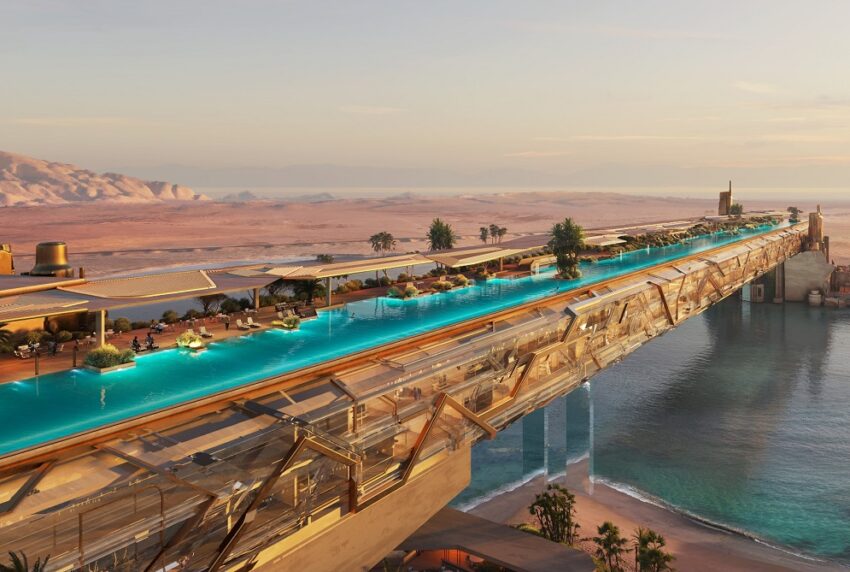
Trojena – a year‑round mountain destination
Set in the highlands of Jebel alLawz at elevations up to 2 600m[9], Trojena will be the Gulf’s first outdoor ski destination. Its moderate climate allows for three months of winter snowfall[10], while the region plans to host a ski village with over 30km of slopes[11]. The destination features clusters such as a futuristic Gateway portal, wellness‑oriented Relax zone, and Valley cluster built around a 2.8km man‑made lake[12]. Trojena’s design maximizes natural assets, offering stargazing, a high‑tech observatory and an 18‑hole mountain golf course[13].
Sindalah – gateway to the RedSea
Sindalah is a luxury island within the NEOM region. The island enjoys a year‑round climate and lies within a marine ecosystem home to over 1000 fish species and 300 coral species[14]. It aims to be a global yachting destination accessible to the Mediterranean—17hours by boat from major yachting ports[15]. Sindalah will provide marinas, resorts and entertainment while protecting marine life.
Magna and coastal wonders
NEOM’s Magna region covers 120km of untouched coastline and reserves 95% of its 406km² area for nature[16]. It promises luxury resorts, rewilding initiatives and coral‑reef regeneration[17]. Visitors will enjoy activities such as deep‑sea diving, wildlife exploration, sailing and an 18‑hole signature golf course[18]. Magna’s design harnesses sustainability and technology to create architecture that harmonizes with the landscape[19].
Saudi Arabia: Qiddiya and Diriyah – cities for play and heritage
Qiddiya City
Located 45km from Riyadh and covering over 360km²[20], Qiddiya City will be the world’s first city built entirely around play. Its plan includes over400 attractions, 275 rides, 12 theme parks, 2000 art installations and 43 sports facilities[21]. It will host 8 metro stations connected to Riyadh’s transport network[22] and provide homes for 500000 residents[23]. Qiddiya aims to be 100% walkable with 20% of land devoted to public spaces[24]. The city will feature SixFlags Qiddiya, Aquarabia water park and a dedicated gaming and e‑sports district[25].
Diriyah – living heritage
Diriyah, the ancestral home of the Saudi royal family and a UNESCO World Heritage site, is being redeveloped into a cultural and lifestyle destination. The Diriyah Company’s masterplan has a SAR236billion budget and includes 28hotels, 566 000m² of retail, 14km² of development area, 1.6millionm² of office space and more than 18000 residential units[26]. The project preserves historic At‑Turaif while adding hospitality, retail and cultural venues.
Saudi Arabia: RedSea Global – regenerative tourism
RedSeaGlobal (RSG) manages several tourism destinations along the kingdom’s west coast. The company states that the RedSea destination opened its first resort in 2023 and will finish phaseone in 2024–25 with 16 resorts and around 3 000 keys[27]. By 2030, it plans 50 hotels with 8000 rooms and 1000 residential properties across 22 islands and six inland sites, limiting visitor numbers to no more than onemillion annually to preserve the environment[28]. Shura Island will host 11 resorts, a marina and an 18‑hole golf course[29]. RedSea International Airport opened for domestic flights in 2023 and began international services in 2024[30].
At AMAALA, phaseone due in 2025 will include the Marina Village and attractions like the Corallium MarineLife Institute and a yacht club[31]. AMAALA covers 4 155km² with 68km of coastline[32] and aims for a 30% net conservation benefit by2040[33]. Visitor numbers will be capped at 500000 annually[34], and the destination will run on 100% renewable energy[35]. Phaseone will feature nine resorts with over 1 600 rooms and the full plan calls for 29 hotels and 3 800 rooms, plus 1 200 luxury residences[36].
Thuwal Private Retreat is a buy‑out‑only island sanctuary on the RedSea. RSG describes it as a 1.7‑hectare island with a three‑bedroom villa and three one‑bedroom pavilions, offering personal concierge services and locally sourced cuisine[37]. This ultra‑exclusive destination emphasizes sustainability and community involvement[38].
Qatar: Smart urban regeneration and coastal leisure
Msheireb Downtown Doha
Msheireb Downtown Doha is the world’s first sustainable downtown regeneration project. Its mission is to rejuvenate Doha’s old commercial center with modern architecture inspired by traditional Qatari heritage[39]. The project covers 31hectares, costs around QAR20billion (US$5.5billion), and includes more than 100 buildings ranging from three to 30storeys[40]. More than 10 000 parking spaces and comprehensive green building measures support the car‑free design[41]. Msheireb aims to create a mixed‑use district for living, working, shopping and culture[42] and is strategically located near Hamad International Airport and the Corniche[43].
Qetaifan Island North
Qatar’s Qetaifan IslandNorth near Lusail City blends leisure and residential offerings. The project spans 1.4millionm², featuring 335 hotel rooms, 10 villas and a waterpark with 58 rides (53 water slides and five dry rides)[44]. The island also includes a linear park, marina, beach club, retail districts and the 85m‑high IconTower[45]. Luxury waterfront residences, hotels and recreational facilities aim to make Qetaifan a family‑friendly entertainment hub.
Kuwait: SilkCity (MadinatAl‑Hareer)
Kuwait’s MadinatAl‑Hareer, or SilkCity, is a visionary urban mega‑project. The Tamdeen Group notes that this KD25billion project was submitted in 2006 with the blessing of the Kuwaiti Municipal Council and state cabinet[46]. Planned for the Subiya region, SilkCity will comprise four quarters—Finance City, Leisure City, Ecological City and Residential City—each with its own centre[47]. The masterplan emphasises high global standards, educational and cultural amenities, and an integrated environment combining innovation and superior design[48]. When built, SilkCity is expected to become a new urban hub connecting Kuwait to the broader region via the Sheikh Jaber Causeway.
Bahrain: BahrainBay – waterfront luxury
BahrainBay in Manama is an opulent mixed‑use development built around three districts—TheWharf, TheGardens and ThePark. The project’s vision presents Bahrain Bay as “a futuristic development of vibrant culture and iconic luxury,” offering stylish dining, waterfront activities and striking architecture[49]. It is marketed as a stellar oasis of luxury living in the heart of Bahrain’s capital[50]. The development partners with global brands such as FourSeasons and features residential towers, hotels and retail spaces.
Oman: Sultan Haitham City – smart city model
Oman’s SultanHaitham City is a newly launched urban development intended as a model of sustainability and innovation. The Ministry of Housing and Urban Planning describes it as a modern, sustainable and smart living experience that combines advanced infrastructure, green spaces and integrated residential and commercial hubs[51]. The project aligns with OmanVision2040, emphasizing smart mobility, environmental preservation and cultural heritage[52]. The execution timeline details the project’s progress: concept visioning in 2022, feasibility studies in 2023, master‑plan approval and groundbreaking in 2024, completion of initial infrastructure in 2025 and community engagement in 2026[53]. Phaseone, completed in 2027, includes residential units, schools, healthcare facilities and commercial zones[54].
Regional mobility: GCC Railway and Dubai’s air taxis
GCC Railway
The GCC Railway aims to connect all six member states through a 2 100km rail network. Bahrain’s Ministry of Transportation explains that the project will provide an alternative to road, air and sea travel, stimulate economic growth and create jobs[55]. The network will link Bahrain to Saudi Arabia via the KingHamad Causeway, a 57km bridge with four road lanes and two rail tracks[56]. Passenger traffic is projected to reach about eightmillion passengers per year by 2050[57]. The line will connect to Bahrain’s planned metro and Saudi Arabia’s domestic rail networks, facilitating seamless cross‑border travel[58]. Completion of the GCC Railway is targeted for later this decade and is integral to unified regional development.
Dubai aerial taxi network
Dubai is set to launch the world’s first commercial urban air taxi service in 2026. A 2025 press release from JobyAviation quotes the director general of Dubai’s Roads and Transport Authority (RTA) saying that RTA is progressing towards the commercial launch in 2026, positioning Dubai as a global hub for sustainable urban mobility[59]. During the DubaiAirshow 2025, Joby completed a 17‑minute piloted flight from Margham to AlMaktoum International Airport[60], demonstrating readiness for point‑to‑point service. The company announced three additional vertiport locations at the DubaiMall, AtlantisTheRoyal and the American University of Dubai[61]. Together with a vertiport at Dubai International Airport, these sites form the initial network for the 2026 launch[62].
Conclusion
Across the Gulf, governments and sovereign entities are transforming deserts and coastlines into sustainable destinations designed for future generations. Saudi Arabia’s NEOM, Qiddiya, Diriyah and RedSea initiatives are redefining how cities are built—emphasizing renewable energy, smart infrastructure and experiential travel. Qatar’s Msheireb Downtown and Qetaifan Island demonstrate the fusion of heritage and modernity, while Kuwait’s SilkCity and Bahrain Bay showcase ambition in urban planning. Oman’s SultanHaitham City reflects a commitment to sustainable living, and regional projects such as the GCC Railway and Dubai’s aerial taxis illustrate a new era of mobility. Together, these projects represent a bold vision for the GCC: a network of futuristic destinations that honour culture, protect the environment and offer visitors unparalleled experiences.
Reference List
- NEOM – The Line. “The Line,” NEOM (official site). Facts about length, height, renewable energy and population capacity[1][4].
- NEOM – Oxagon. “Oxagon,” NEOM (official site). Information about Industry 4.0 integration and renewable energy[6] and community design[8].
- NEOM – Trojena. “Trojena,” NEOM (official site). Details on elevation, climate, ski experience and facilities[9][63].
- NEOM – Sindalah. “Sindalah,” NEOM (official site). Marine ecosystem and Mediterranean accessibility[14][15].
- NEOM – Magna. “Magna,” NEOM (official site). Coastal length, conservation commitments and activities[16][18].
- Qiddiya City. “Qiddiya City: Where Play Comes to Life,” Qiddiya Investment Company (official site). Data on size, attractions, metro stations and population[64][21].
- Diriyah Company. “Diriyah Company,” Diriyah Company (official site). Masterplan statistics including development budget, hotels, retail space and residential units[26].
- Red Sea Global. “Red Sea Global – Official Site,” Red Sea Global (official site). Overview of portfolio and timeline[65]. “The Red Sea” project page – details of phase one, hotel numbers and visitor caps[28], Shura Island and airport information[66]. “AMAALA” project page – facts on area, conservation, visitor caps and resort numbers[67]. “Thuwal Private Retreat” – description of island size and facilities[37][38].
- Msheireb Downtown Doha. “About Msheireb Downtown Doha,” Msheireb Properties (official site). Description of sustainable regeneration project, key figures and location[68].
- Qetaifan Island North. “Qetaifan Projects” (official site). Data on island area, hotel rooms, villas, waterpark rides and Icon Tower height[69].
- Madinat Al‑Hareer (Silk City). “Madinat Al Hareer,” Tamdeen Group (official site). Project description, approval and four‑city plan[70].
- Bahrain Bay. “Bahrain Bay Development,” Bahrain Bay (official site). Description of mixed‑use development and luxury experience[49].
- Sultan Haitham City. “Sultan Haitham City,” Ministry of Housing and Urban Planning, Oman (official site). Project overview, vision, execution timeline and goals[71][72].
- GCC Railway. “GCC Railway,” Ministry of Transportation and Telecommunications of Bahrain (official site). Purpose of the project, King Hamad Causeway details and passenger projections[73].
- Dubai Air Taxi Network. “Dubai Air Taxi Network Takes Flight,” Joby Aviation press release (with RTA statement). Information about the 2026 launch, first piloted flight and vertiport locations[59][61].
The post Qiddiya Alongside Lusail City, Masdar, Trojena, and Sindalah will See Floating City, Flying Vehicles and Whatnot- The GCC’s Game-Changing Cities You Need to Know About! appeared first on Travel and Tour World