
















Con Dao Lead Southeast Asia’s Shift to Low-Carbon Tourism and Zero-Waste Islands
-
Travel, Food, Immigration, Religion
-
-
15 mins
-
Travel and Tour World
-
Shreya Saha
-


Explore how Southeast Asia micro-islands pioneer sustainable island tourism with microgrids and visitor caps.
The fragility of the insular territories within Southeast Asia has been highlighted by the traditional mass tourism paradigm which focuses on the unlimited flow of passengers at the expense of ecological equilibrium. In an effort to counter the problems brought about by the excessive pressure and destruction of the environment, these peripheral territories are adopting new paradigms of governance. The shift from growth through volume has led to the development of micro island clusters in Vietnam, Thailand and the Philippines into managed living laboratories. The adoption of decentralized renewable power systems, carrying capacity limits and waste management systems has made this possible.
The Archipelagic Paradox: Structural Failure of the Mass Tourism Paradigm
For decades, insular territories across Southeast Asia were treated by national development strategies as engines for high-density, low-yield leisure migration. Economic trajectories anchored to unrestrained passenger footfall were engineered by massive tourism hubs such as Phuket, Bali, and Boracay, creating structural environmental bottlenecks by which the natural assets underpinning their appeal were ultimately compromised. Unsustainable burdens were placed by these intensive commercial corridors on unconfined coastal aquifers, delicate littoral zones were inundated with unsegregated refuse, and municipal infrastructure was locked into carbon-intensive operational models.
Central to this structural degradation is the archipelagic energy penalty, often termed the “island multiplier.” Historically, three to five times more per unit of basic electricity was paid by off-grid islands compared to mainland metropolitan grids. This disparity was driven by maritime freight overheads, thermal inefficiency in small generator units, and the logistical risks associated with barging refined diesel and heavy fuel oil through unpredictable waters.
The systemic vulnerability of this volume-first paradigm was laid bare by state-mandated environmental closures across the region, most notably Boracay’s temporary rehabilitation closure in 2018 and the multi-year preservation shutdown of Maya Bay in Thailand. It was demonstrated by these crises that proactive carrying-capacity limits cannot be replaced by post-hoc remediation.
In response, an archipelagic transformation has been established across three peripheral island clusters:
- The Côn Đảo Archipelago in Vietnam
- The Koh Mak Archipelago in Thailand
- Siquijor Province in the Philippines
Rather than functioning as peripheral satellites to mainland commercial markets, these micro-islands are operated as regulatory testbeds. Emulating the Astypalaia living-lab framework in the southern Aegean Sea, it is being demonstrated by these Southeast Asian communities that sustainable island tourism can be realized through distributed infrastructure, statutory quotas, and closed-loop material flows.
Territorial Focus: Gateways and Jurisdictional Geographies
Policy execution, capital flows, and physical operations can be traced by mapping the logistics corridors connecting these remote laboratories to their respective mainland economic centers.
In Vietnam, the Côn Đảo Archipelago sits roughly 185 kilometres south of Vũng Tàu City and is administered directly as a district within Bà Rịa–Vũng Tàu Province. Sixteen islands are comprised within the archipelago, with Côn Sơn serving as the primary hub for administrative life, historical monuments, and commercial habitation. Access is channeled through two tightly monitored arterial routes: scheduled regional aviation flights departing Ho Chi Minh City’s Tân Sơn Nhất International Airport into Cỏ Ống Airport, and high-speed commercial passenger ferries sailing from the Vũng Tàu ferry terminals directly to Bến Đầm Port. Through this geographic separation, Côn Đảo has been positioned as Vietnam’s designated trial ground for national circular economy directives, structured under formal decisions by the Bà Rịa–Vũng Tàu Provincial People’s Committee.
Thailand’s designated living lab is the Koh Mak Archipelago, located in the eastern Gulf of Thailand between Koh Chang and Koh Kood within Trat Province. Operating under the administrative oversight of the Ko Mak Subdistrict Administrative Organisation, the low-lying island’s socio-economic activity is centered on the coastal settlements of Ao Nid and Ao Kao. Connectivity to Bangkok requires overland transit to Trat City, followed by high-speed maritime passenger launches leaving Laem Ngop Pier. Koh Mak has been designated as the flagship deployment site for Thailand’s Designated Areas for Sustainable Tourism Administration (DASTA Area 2), through which the island has been shaped into the country’s first formally audited low-carbon destination.
In the Philippines, the living-lab experiment in the Central Visayas is anchored by the island province of Siquijor. Nestled south of Bohol and southeast of Negros Oriental, municipal operations are directed through the tourism strip of San Juan, the eastern agricultural district of Maria, and the primary maritime gateway at Siquijor Port. Passenger and freight vessel connections routed through Dumaguete City and Cebu City are relied upon by the island. Siquijor serves as the country’s foremost testbed for off-grid Distributed Energy Resources and community-driven zero-waste management.
Pillar I: Decentralised Clean Energy Microgrids and Last-Mile Electrification
The breaking of historical reliance on imported fossil fuels is identified as the core requirement of archipelagic decarbonisation. For decades, island utility models were constrained by short-term fiscal planning, leaving communities dependent on heavy fuel oil, diesel gensets, and regressive state fuel subsidies.
Overcoming the Island Multiplier and Diesel Subsidies in Siquijor
In the Philippines, off-grid power generation was historically assigned to the Small Power Utilities Group of the National Power Corporation (NPC-SPUG). Because substantial operational costs were routinely incurred by diesel generation in remote territories, remote power was subsidised under national regulatory structures via the Universal Charge for Missionary Electrification (UCME), protecting consumers from the full cost of thermal fuel generation. On Siquijor, power distribution is managed by the Province of Siquijor Electric Cooperative (PROSIELCO), by which capacity is purchased from thermal independent power producers running bunker-C and diesel engines. Severe economic exposure was created by this structure; rolling blackouts across the island’s tourist corridor in San Juan were regularly triggered by global oil spikes and mechanical breakdowns at local power plants.
To address these vulnerabilities, a clean-energy transition anchored in the municipality of Maria was initiated by the Philippine Department of Energy alongside the National Electrification Administration and private project developers. A ground-mounted solar photovoltaic system paired with a battery energy storage system was introduced by the project, directly connected to PROSIELCO’s distribution network. Grid frequency is stabilized and expensive diesel generation is offset by this installation, insulating peak operational capacity from imported fuel shocks. Simultaneously, commercial-scale rooftop solar arrays have been installed by boutique resorts in San Juan through net-metering schemes, using decentralised renewable microgrids to lower daytime commercial draw on the local grid.
On Koh Mak, a decentralized, community-scale approach was selected by DASTA rather than a single large solar plant. Working with subdistrict administrators and resort operators, the rollout of distributed rooftop photovoltaic arrays across municipal offices, public piers, and private bungalows was facilitated by the agency. Supported by smart metering systems installed by Thailand’s Digital Economy Promotion Agency, cold-storage facilities and reverse-osmosis water purification plants are fed by these solar installations during peak daylight hours, local solar self-consumption being maximized and the island’s overall carbon footprint being reduced.
Terrestrial E-Mobility and Last-Mile Connectivity
A clean foundation for island transport is created by the decarbonisation of electricity generation. On small islands where road networks are short and enclosed, micro-mobility fleets are well suited for electrification.
In Côn Đảo, strict green transport rules were introduced by the Bà Rịa–Vũng Tàu provincial authorities as part of their sustainable development strategy. Fleets of electric passenger shuttles and low-speed electric vans were systematically deployed by the district government along the coastal road corridor linking Bến Đầm Port and Cỏ Ống Airport with Côn Sơn town. Roadside noise was curbed and substantial exhaust emissions near sensitive national park boundaries were eliminated by the municipality through the replacement of aging internal combustion buses with battery-electric transit.
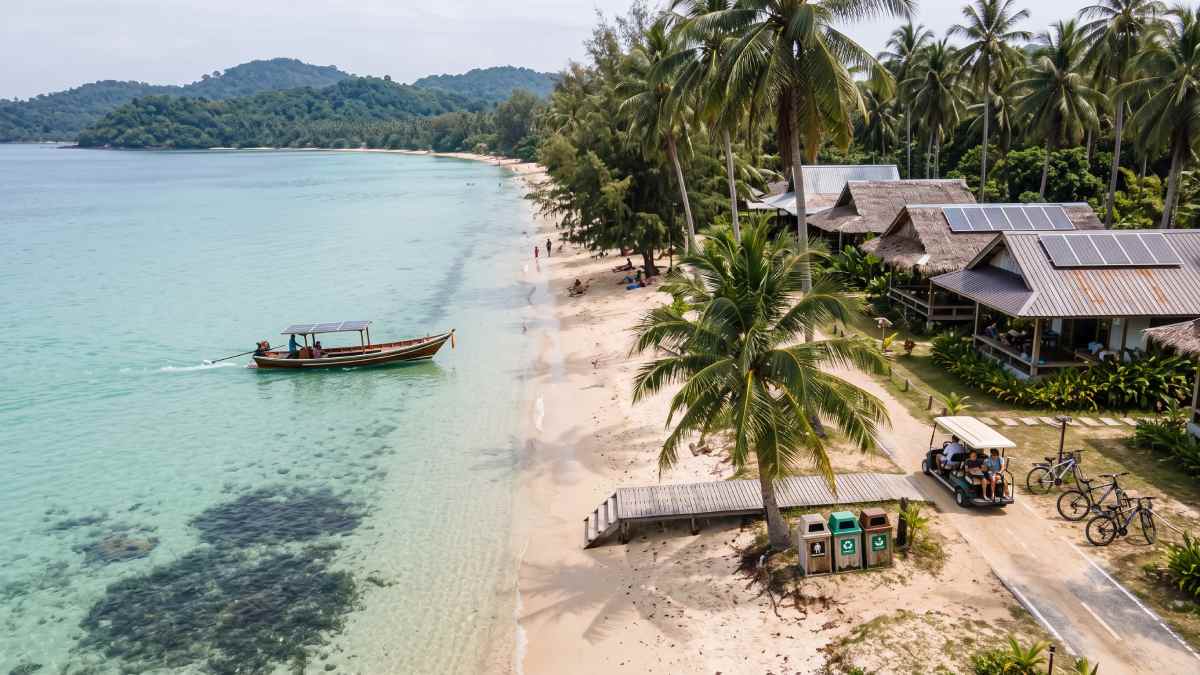
An even firmer regulatory framework was adopted by Koh Mak, using local transport ceilings to preserve its environment. Private automobiles are prohibited from being carried to the island by roll-on/roll-off vehicle ferries under the Koh Mak Charter. Travel is undertaken by visitors on foot, via rented communal bicycles, or through solar-charged communal golf buggies. Commercial rental scooters were capped at a strict proportion relative to total operational guest rooms across the island by the subdistrict so that traffic congestion and moped accidents could be prevented.
In Siquijor, a phased transition of the transit system was launched by the provincial board, whereby high-emission two-stroke passenger tricycles were replaced with solar-assisted electric tricycles across the San Juan and Larena circuits. These vehicles are recharged using distributed community solar charging hubs, demonstrating that public transport can be cleaned up while operational fuel costs are reduced for local drivers.
Marine Propulsion Retrofits and Coastal Decarbonisation
While terrestrial electrification has progressed rapidly, cleaning up marine transport remains a technical challenge. Nearshore leisure travel across Southeast Asia—including inter-island transfers, reef snorkeling tours, and diving excursions—was long sustained by converted automotive diesel engines or noisy two-stroke outboards. Unburned hydrocarbons were discharged and persistent underwater acoustic pollution was generated by these engines, disturbing marine life in shallow coral systems.
On Koh Mak, experimental pilot programs testing solar tenders and swappable electric outboards were launched by DASTA in partnership with marine engineering teams. These systems are operated on fixed tourist routes, such as the short transfer from Ao Suan Yai to the volcanic islet of Koh Kham. Silent operation and zero emissions are achieved by these boats through the use of high-torque electric motors powered by lightweight lithium-iron-phosphate battery packs.
In Côn Đảo, similar electric marine conversions are being tested by park authorities for patrol craft and small tourist boats operating around protected coral zones, including Hòn Cau and Hòn Bảy Cạnh. It is demonstrated by these marine propulsion retrofits that small coastal vessels can be operated cleanly, protecting sensitive reef ecosystems while operators are shielded from the high costs of retail marine fuel.
Pillar II: Statutory Carrying Capacities and Community Governance
It is acknowledged that small islands cannot be protected by technological interventions if visitor volumes are permitted to expand indefinitely. Efficiency gains achieved from renewable microgrids and electric transport are quickly erased by excessive tourist footfall if firm legal caps are not maintained. To safeguard ecological stability, statutory carrying capacities and community-enforced charters are being established by Southeast Asia’s micro-island living labs.
The Koh Mak Low-Carbon Charter: An Eight-Point Community Covenant
Koh Mak’s model is anchored in the Koh Mak Charter, a community agreement negotiated by the Koh Mak Tourism Community Enterprise, local village leaders, and DASTA Area 2. Development trajectories were reclaimed by local residents rather than left to distant national ministries, resulting in the drafting and ratification of eight community commitments:
- Tourist vehicles are prohibited from being transported to the island via car ferries.
- Commercial rental motorbikes are capped at a set ceiling relative to operational hotel rooms on the island.
- Styrofoam food packaging and environmentally damaging single-use containers are prohibited.
- An absolute ban on littering and dumping untreated waste in public spaces and waterways is enforced.
- The agricultural and landscape application of chemicals with high toxic residues is prohibited.
- A strict noise curfew barring loud nightlife during night and early morning hours is enforced.
- Motorized personal watercraft, including jet skis and motorized speedboards, are banned.
- The transport, consumption, and sale of illegal narcotics are strictly prohibited.
The island’s tranquility is preserved and overdevelopment is averted through local peer pressure, business licensing, and community consensus. Shallow seagrass meadows and fringing reefs are shielded from propeller damage and acoustic stress through the exclusion of motorized watercraft.
Simultaneously, an informal commercial room cap is maintained across the island by its five founding landholding families. The coastline is protected from massive concrete resort developments and visitor numbers are kept well within carrying capacity through this voluntary zoning restraint.
Biological Thresholds and Quotas in Côn Đảo National Park
In Vietnam, carrying capacity is managed in Côn Đảo through strict national park administration and wildlife protection quotas. Marine nursery grounds supporting vital regional nesting populations of Green Turtles (Chelonia mydas) and Hawksbill Turtles (Eretmochelys imbricata) are encompassed within Côn Đảo National Park, which was designated a Ramsar wetland site and an ASEAN Heritage Park.
To safeguard these habitats, strict visitor limits were established by park authorities on nocturnal eco-tours to the primary rookery on Bảy Cạnh Island. Nightly headcounts are imposed on commercial tour operators, and registration with park rangers alongside accompaniment by certified guides is mandated for all visitors. Silence is strictly required on the nesting beaches of Bãi Cát Lớn, while flash photography and artificial torches are prohibited.
Remarkable conservation gains have been supported by these governance controls: thousands of nests were safely protected and vast numbers of turtle hatchlings were released into the sea by rangers and volunteers. It is proven by the park that high-value eco-tourism can be conducted alongside active species conservation when tourist visits are tied to strict biological limits.
Automated Fiscal Levers and Ring-Fenced Conservation Levies
Dedicated environmental user fees are being implemented by micro-islands to finance local conservation. In the Philippines, an environmental fee collected from incoming passengers was established in Siquijor at seaport terminals in Larena and Siquijor Port. Rather than being absorbed into national treasury accounts, these funds are ring-fenced for municipal environment offices. Barangay waste management, marine sanctuary marker buoys, and community patrols protecting local marine reserves are directly funded by this revenue.
A comparable digital fee system is utilized by Côn Đảo at Cỏ Ống Airport and Bến Đầm Port. Environmental fees are collected digitally and routed straight into the national park’s conservation budget and local circular economy projects, funding waste diversion and marine preservation. A sustainable finance mechanism that grows alongside the tourism sector is established by linking visitor arrivals to conservation funding.
Pillar III: Circular Economy Architecture and Zero-Waste Infrastructure
The traditional linear economic model—where goods are imported, consumed, and discarded—is disastrous for small islands. Landfill space is scarce, and marine life and coastal reefs are quickly damaged by improper waste disposal. To tackle this, a transition to a circular zero-waste architecture is being pursued by these micro-islands.
The 5-No’s Policy and Sacred Site Waste Mitigation in Côn Đảo
An integrated circular economy pilot plan running to 2025 with progressive decadal targets was launched in Côn Đảo under the Bà Rịa–Vũng Tàu Provincial People’s Committee, supported by dedicated public and private financing. Substantial domestic solid waste diversion through circular systems, local processing of organic waste, rainwater collection integration, and coral reef restoration are targeted by the program.
A standout initiative is the “5-No’s” Policy (“5 Không”), formulated alongside the WWF-Vietnam Plastic Smart Cities program to tackle plastic and ritual waste at the island’s historical and religious shrines, particularly Hàng Dương Cemetery:
- Single-use plastic trays are banned and replaced with reusable bamboo and composite offering baskets provided at shrine entrances.
- Synthetic floral foam blocks are banned, eliminating a major source of microplastic pollution in coastal soils.
- Single-use plastic carrier bags and disposable plastic bottles are prohibited, reusable containers being encouraged in their place.
- Heavily wrapped commercial offering packages are excluded, vendors being shifted toward natural, biodegradable wrapping.
- The open burning of votive paper goods is prohibited, ending the air pollution and toxic ash runoff once caused by ceremonial furnaces.
Stubborn plastic and paper waste was eliminated at the source by aligning traditional spiritual customs with practical environmental protection. It was demonstrated that waste reduction can succeed when combined with cultural respect and community engagement.
Decentralised Materials Recovery Facilities in Siquijor
In the Philippines, solid waste management was completely overhauled in Siquijor without the construction of costly centralized incinerators. In partnership with the Mother Earth Foundation and the Global Alliance for Incinerator Alternatives, Provincial Ordinance No. 2018-185 and Plastic-Free Ordinance No. 2019-120 were passed by the provincial board. A village-level sorting program supported by dedicated municipal Zero Waste Task Forces was established by these measures.
Waste separation was decentralized down to the village level rather than mixed refuse being shipped to an overflowing central landfill. Dedicated Materials Recovery Facilities and specialized containment eco-sheds are operated across a wide majority of the province’s barangays, house-to-house collection of properly separated waste streams being conducted by local workers.
Community agro-forestry and coconut plantations are nourished through the local composting of organic food waste, while dry recyclables are processed and sold to scrap buyers. Backed by municipal spot fines for illegal dumping, a verified high municipal waste diversion rate was achieved by Siquijor, proving that waste challenges on remote islands can be resolved by community-led initiatives.
Closed-Loop Hospitality and Water Recycling Systems
This circular framework is reinforced by private hospitality investments across the region. Sustainable systems have been integrated directly into resort operations by high-end eco-lodges, such as Six Senses Côn Đảo.
An on-site reverse osmosis desalination plant is run by the resort to purify seawater for drinking purposes, packaging it in reusable glass bottles and eliminating tens of thousands of single-use plastic bottles each year.
Clean electricity and water heating are provided by rooftop solar panels and solar thermal arrays, while resort greywater is treated through biological membrane bioreactors and reed-bed wetland systems. Organic fruit and vegetable gardens are irrigated with the filtered water, nutrient runoff being prevented and nearby coral reefs being protected from algae blooms and eutrophication.
Operational Dilemmas: The Counter-Narrative of Island Decarbonisation
Moving toward carbon neutrality on remote islands presents significant operational challenges despite substantial progress. Tensions often emerge between local environmental priorities and top-down infrastructure plans directed from mainland capitals.
Subsea Transmission Cables Versus Autonomous Microgrids
The most pressing infrastructure question facing island planners is whether self-contained renewable microgrids should be constructed or high-voltage subsea cables should be run back to the mainland.
In September 2025, Côn Đảo was linked directly to the national electricity grid through a major high-voltage infrastructure project executed by Vietnam’s national utility, Vietnam Electricity. Extensive subsea and underground cable networks were laid across Côn Sơn Island under substantial state and utility financing.
Long-standing power deficits were resolved, expensive local diesel barging was eliminated, and the capacity needed to electrify road transport was provided by connecting to the mainland grid. Yet a clear ecological trade-off was also introduced: a sustainable eco-tourism destination was connected directly to a national power grid that remains heavily reliant on fossil energy sources.
By contrast, full local control and zero direct generation emissions are retained by self-contained island microgrids, such as Siquijor’s solar-plus-storage development in Maria. However, ongoing economic hurdles are faced by these decentralized setups, including recurring battery replacement costs, voltage fluctuations during prolonged overcast seasons, and difficulties in securing long-term private financing.
Capital Expenditure and Maintenance Bottlenecks in Marine Electrification
Commercial marine craft electrification remains far more challenging than the adoption of land-based electric vehicles. Marine-grade lithium-iron-phosphate battery banks, sealed waterproof motors, and heavy-duty charging docks along the shore are required when converting passenger ferries and wooden longtail boats to electric propulsion.
Ordinary battery equipment degrades quickly, suffers corrosion, and risks thermal management failures in hot, humid, saltwater environments. High upfront capital costs for reliable electric outboard setups place conversions out of reach for small, independent boat operators unless low-interest government loans or subsidies are provided.
Compounding the problem, few certified marine electricians reside on isolated islands, meaning that an operator may be left without a livelihood for extended periods during an inverter fault or electrical breakdown while specialized parts are awaited from the mainland.
The Looming Runway Paradox: Capacity Expansion Versus Conservation Caps
Perhaps the greatest threat to carrying-capacity governance comes from transport infrastructure mismatches. While strict daily visitor caps are established by island communities and park authorities, airport and port expansions are frequently pursued by mainland transportation ministries to maximize economic throughput.
On Côn Đảo, Cỏ Ống Airport operates with a short runway that can only accommodate regional turboprop aircraft and small regional jets, natural tourist arrivals being capped as a result. However, lengthening the runway to handle larger narrow-body commercial jets has been planned under civil aviation master frameworks, aiming to multiply annual passenger capacity substantially.
Limited freshwater reservoirs would be severely strained, municipal wastewater treatment would be overwhelmed, and intense pressure would be placed on turtle nesting beaches across neighboring islets if tourist arrivals were multiplied to such levels.
To reduce surface road impacts between the airport and the town center, an aerial cable car avoiding road clearance through protected national forests was proposed by officials. Yet, without strict legal limits on total daily airline seat allocations, low-impact eco-destinations risk being transformed into overcrowded tourist hubs through the expansion of airport runways.
Cross-Jurisdictional Comparative Intelligence and Performance Metrics
The essential governance, utility, and ecological frameworks across these three jurisdictions are synthesized in the table below:
| Comparative Dimension | Côn Đảo Archipelago (Vietnam) | Koh Mak (Trat, Thailand) | Siquijor Province (Philippines) |
| Mainland Gateways & Ports | Ho Chi Minh City (Air) / Vũng Tàu (Sea) | Bangkok (Transit) / Trat City & Laem Ngop | Dumaguete City & Cebu City (Ferries) |
| Primary Regulatory Authorities | Bà Rịa–Vũng Tàu People’s Committee, MONRE | DASTA Area 2 & Ko Mak Subdistrict Administration | Provincial Board of Siquijor, MENRO, DOE |
| Clean Energy Blueprint | High-voltage subsea cable link plus solar pilot | Distributed rooftop solar with smart IoT meters | Solar and battery storage hybrid microgrid |
| Mobility Transformation | Electric shuttles and municipal EV passenger buses | Bicycle-first policy, EV carts, and rental scooter caps | Solar-assisted e-tricycles and acoustic buffer zones |
| Waste Management Model | Circular Economy Pilot Plan and “5-No’s” Policy | Koh Mak Charter packaging bans and composting | Barangay Materials Recovery Facilities network |
| Carrying Capacity Limits | Nocturnal turtle rookery visitor quotas | Commercial guest room ceiling and watercraft bans | Seaport environmental fees and marine buffer zoning |
| Marine Protected Areas | Ramsar wetland and ASEAN Heritage turtle corridors | Coral nurseries and dedicated seagrass center | Marine protected area network and reef sanctuaries |
Strategic Policy Implications and Future Outlook for Sustainable Island Tourism
It is demonstrated by the operational lessons emerging from Côn Đảo, Koh Mak, and Siquijor that traditional economic assumptions must be re-evaluated if genuine destination resilience is to be achieved. Environmental stability on small islands is inevitably threatened by unchecked tourism expansion. Coordinated action across three key policy fronts is required:
First, island self-sufficiency must be safeguarded in energy planning. While stable grid power can be provided by subsea transmission cables, local investments in solar power and battery storage should be supplemented rather than replaced. Island continuity during mainland grid failures is ensured and vulnerability to external energy market shocks is reduced by maintaining decentralized microgrids.
Second, targeted financial mechanisms must be deployed by governments to decarbonize marine transport. Low-interest financing and duty exemptions should be offered by regional maritime agencies and environmental ministries to help small-boat operators invest in electric outboards and marine battery setups. Technical longevity across local fleets must be supported through marine electrical apprenticeship programs.
Third, transport infrastructure planning must be tied directly to biological carrying capacities. Runway and seaport expansions should not be authorized without calculating an island’s actual resource limits, including drinking water supplies, wastewater absorption capacity, and critical wildlife corridors. Passenger volumes can be prevented from outstripping municipal infrastructure through statutory visitor quotas and automated conservation fees.
Ultimately, an actionable blueprint for fragile island communities worldwide is provided by these Southeast Asian living labs. The systemic decoupling of tourism from ecological degradation has been achieved through community covenants, circular waste infrastructure, and clean energy deployment. Authentic sustainability is proven to endure only when rigid ecological boundaries are positioned as the definitive foundation of regional policy.
These peripheral living laboratories confirm that island resilience requires rigid ecological boundaries to supersede volume-driven tourism models. By harmonising decentralised clean utilities, circular waste systems, and community covenants, Southeast Asia’s micro-islands present an enduring operational template, proving that long-term economic viability is achieved only when statutory conservation limits dictate tourism policy.
Conclusion
Such peripheral laboratories of life demonstrate that true destination resilience demands that volume-based tourism systems be supplanted by ecological limits. In reconciling decentralised renewables, charter adherence by communities, and circular zero waste systems, the micro-islands of Southeast Asia show that true sustainability is achieved only when conservation laws drive tourism policy.
island tourism
The post Con Dao Lead Southeast Asia’s Shift to Low-Carbon Tourism and Zero-Waste Islands appeared first on Travel and Tour World














































































