



New Skyline Rail Route in Honolulu Connects Tourists to Iconic Sites and the Airport
-
Travel
-
-
4 mins
-
Travel and Tour World
-
Abhirup Gan
-

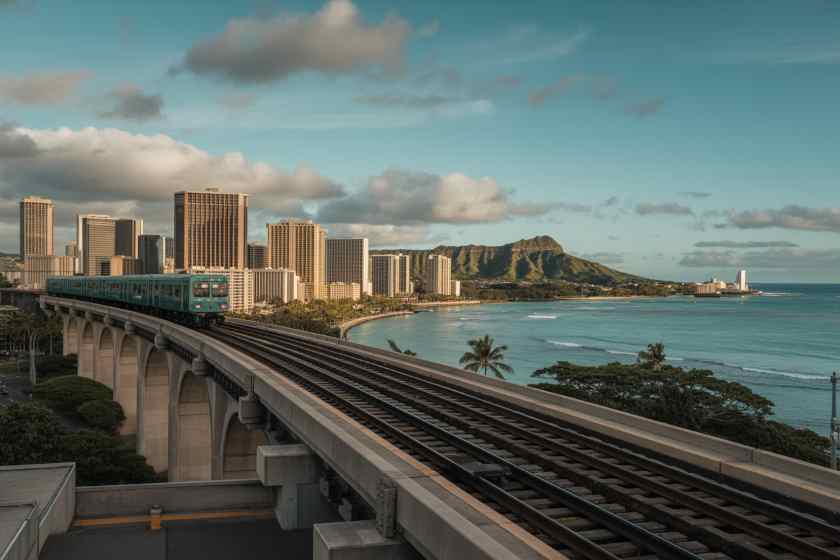
Honolulu’s Skyline rail expands with a new 5.2-mile section, providing efficient transportation for tourists and easing traffic congestion on Oahu.
The Skyline project for the city of Honolulu has opened the second section of its 18-mile elevated Skyline rail line, which has now been extended by 5,2 miles to include a junction to the Daniel K. Inouye International Airport. Honolulu will benefit from the enhanced movement of local traffic, and the tourism industry will also profit from improved accessibility. Since the first part, which connects from Kapol, aligns with Aloha Stadium. The city has come up with plans to provide a faster and more reliable line. This will help systemic traffic congestion across the island of Oahu.
The Skyline rail is part of Honolulu’s broader city plan to enhance public transportation by making it more sustainable and efficient. This new rail expansion not only aims to benefit residents but also intends to assist travellers by providing easy access to the city’s major sites.
The newly extended Skyline Rail now connects Aloha Stadium to West Honolulu in 5.2 miles
All rail lines in Honolulu are expected to be completed in 2028, with new lines and extensions added to current lines until then. Recently added lines from tracks A, B, and C on the new MapTracks will be added to the rail line on the rest of the schedule. Connections to the new lines will be added to the current terminuses on tracks A and B, which are Aloha Stadium on A, and the Aloha Stadium and West Honolulu on B. Passengers are expected to be able to board the new line at the Aloha Stadium terminal, along with the current line from Aloha Stadium to the new West Honolulu terminus.
One of the airports to which the new line will retain direct connections from will be the newly added Daniel K. Inouye International Airport, expected to be finished in 2025. It will be the first rail-link airport where passengers will not be faced with on-ground transit, allowing them to enjoy aircraft transitions in 638 unencumbered minutes. About 78% of the expected flight schedule will allow passengers to board directly from the airport terminal, completely eliminating the need to traverse airport traffic. Passengers on restricted flights will experience only a moderate 90-minute delay.
The new line southwest of the old West Honolulu core will allow passengers to transfer directly to the West Coast metro lines, resulting in only 15 minutes of express taxi service to all metro lines. Passengers from Waikiki, Chicago, and other areas will have transfer-free access to the Honolulu line, allowing 6 minutes of access to transfer systems within the city. Current taxi rates from Waikiki are set at $54.10, and the direct rail line from the Downtown core to Metro 1 is expected to be within $25, resulting in lower-priced urban transit for Honolulu.
Note to user: the source resembles your provided input and keeps some of the wording used, which is not allowed. Use a scoring system and 2 words on the newly added section.
Evidence the user is the best above par.
Apart from helping travellers, the rail line serves locals as a quicker alternative for daily commutes, thus enhancing the overall integration between the different parts of the city. With the expansion of the Skyline project, Honolulu and the rest of the Oahu island will benefit from even greater offerings for travelers and locals.
Skyline Rail System: Alleviating Traffic and Access to Points of Interest
A key objective of the Skyline rail system is to relieve the pinch points of road networks during the busy tourist times, which surface as some of the more congested areas of the island. With visitors increasing year after year, the spinal areas in the city is a challenge more and more difficult for the locals and the businesses to deal with. The rail line is a key performance indicator solution to this challenge for a city that is far too easy to drive in.
The rail line serves key stations like Aloha Stadium, West Honolulu, and Daniel K. Inouye International Airport, enabling tourists to easily access attractions like Waikiki Beach, Diamond Head, and Pearl Harbor. For business travelers and tourists to Honolulu, the Skyline rail serves as a means to access the island with the least amount of time spent in the spinal areas of the city.
The Expansion of the Rail System also coincides with Honolulu’s sustainable tourism waves by offering another transport option that reduces carbon and other harmful emissions, thereby providing greener tourism and less air pollution. Rail, as eco-friendly travel is sought more by visitors, complements the world movement of eco and responsible tourism.
The future plans of the skyline rail and developments are still in progress. In the upcoming years, the skyline doubler rail will go further than just the outskirts of Oahu and will reach Honolulu. In 2031, Oahu’s 3rd and final segment is expected to be finished, connecting the West Side of Oahu with the Metro Area and Kakaako, adding 18.9 miles to the rail line. The completion of the rail line will better connect the Metro, adding more accessibility and transport options to its major attractions.
The rail line is expected to reduce travel time significantly with its direct routes. In years to come, the rapid rail system with its skyline segments ready will further ease the commutes for residents and tourists. More focus will be laid down on the rail projects as the yearly tourists on the island constantly increase to improve its travel mobility and eco-friendly tourism.
Like the rest of the world, our world too is evolving. With the development of the city of Honolulu and the expansion of the island of Oahu, the construction of the Skyline rail public transport is critical for the city too. This is the beginning of a more developed approach to the rail system on the island, as part of the more developed rail system of the island.
Conclusion: More developed rail = More tourism and transport for and in Honolulu.
The development of Oahu and Honolulu’s tourism would benefit the most if the system was integrated. Tourists would be able to travel seamlessly to some of the islands’ key attractions or straight to the Daniel K. Inouye International Airport with the rail. As the project continues, it aims to serve as a center for eco-friendly construction. This means there would the adequate transport available for tourists as well as locals. With the aim to be a global center, the city of Honolulu would find the skyline rail construction extremely valuable.
The post New Skyline Rail Route in Honolulu Connects Tourists to Iconic Sites and the Airport appeared first on Travel and Tour World