








MICHAEL GUILLEN: Science's fantastic discoveries are making religion more credible
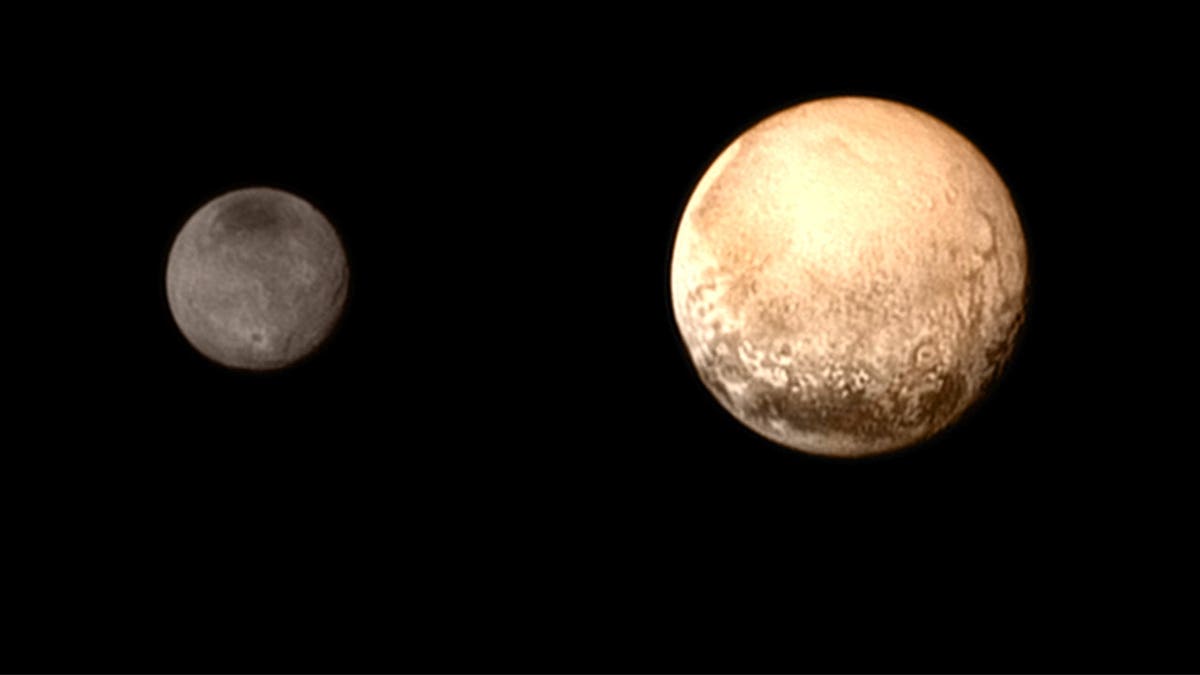


Dark matter and dark energy account for 95% of the cosmos, meaning science is based on only 5% of what's real, deepening the universe's mystery.
I’ll never forget the time I received my very own microscope for Christmas; suddenly, a drop of pond water became a teeming cosmos of strange, wriggling creatures. Nor will I ever forget peering through my first telescope; suddenly, the moon’s eerie, cratered surface exploded to life and looked close enough for me to touch.
Those two boyhood experiences tell the entire, exciting, unexpected story of science in a nutshell. With every new, more powerful imaging device, scientists have gradually, spectacularly brought to light the once-shrouded secrets of the microscopic and macroscopic cosmos.
Throughout this long, impressive eye-opening drama, scientists have justifiably boasted about how their discoveries are systematically ridding our species of its hoary, benighted superstitions, religion included. This conceit is displayed in the title of Carl Sagan’s book The Demon-Haunted World: Science As a Candle in the Dark. For Carl — a professor of mine at Cornell — science was indeed the great, bright hope for a terribly dim-witted world.
NASA'S CHANDRA TELESCOPE REVEALS MILKY WAY'S OUTER REACHES MAY STRETCH FARTHER THAN PREVIOUSLY KNOWN
But, the story of science hasn’t turned out as the optimists prophesied, not by a long shot. That’s because modern science is discovering there’s far, far more to reality than meets the eye, than even our most sensitive instruments can see. That we live in a demon-haunted cosmos after all — one infested with invisible, inscrutable spirits with such names as dark matter and dark energy.
As a grad student at Cornell, I recall learning about what my astronomy professors called the "missing mass problem," a mystery dating back to 1933, when Swiss astronomer Fritz Zwicky used data from Mount Wilson Observatory’s powerful Hooker telescope to study clusters of galaxies. To his astonishment, Zwicky discovered that galaxies are swarming within each cluster like bees in a hive at a much faster clip than conventional physics can explain.
In class, I learned that these clustered galaxies would need to have roughly ten times more mass to explain their unusual swiftness. This means that most of the galaxies’ collective mass is "missing" — is invisible to us. Zwicky called this ghostly mass "dunkle materie," German for dark matter.
Scientists today offer many fanciful, high-brow explanations for dark matter, but the plain truth is that, nearly a century after Zwicky’s discovery, we still have no idea whatsoever what it is. For now, the consensus is that, like conventional matter, dunkle materie is gravitational in nature — which is why it can tug on and speed up the clustered galaxies. But, very unlike conventional matter, dunkle materie does not radiate or reflect light — which is why it’s invisible.
FROM COCKROACH MILK TO STEPPING ON SNAKES, IG NOBEL AWARDS CELEBRATES SCIENCE AT ITS ODDEST
It wasn’t the first time data from the powerful Hooker telescope near Pasadena, California, delivered a scientific bombshell. Back in 1929 American lawyer-turned-astronomer Edwin Hubble used that very same instrument to discover that the universe is expanding. Thereafter, astronomers simply assumed the expansion was slowing down, owing to the universe’s collective gravity putting the brakes on it.
But, in 1998, the story of science took yet another startling turn to the dark side, when two separate teams of astronomers discovered that the expansion of our universe is actually speeding up, not slowing down. This implies the existence of an invisible, inscrutable, repulsive "something" that permeates the whole of our universe.
At a 1998 symposium at the Australian Academy of Science in Canberra, University of Chicago cosmologist Michael Turner gave the "something" a name: dark energy. But giving the phantom material a name doesn’t explain it. To this day, as with dark matter, dark energy remains a complete mystery — notwithstanding the countless published but unsupported attempts to explain it.
The discoveries of dark matter and dark energy would rate little more than a sensational footnote in the impressive story arc of science were it not for one very inconvenient truth. Today, scientists reckon that, all told, the two shadowy spirits account for ninety-five percent of the observable cosmos (never mind the existence of the totally unobservable cosmos beyond the Cosmic Horizon). Ninety-five percent!
DR MARC SIEGEL: I WENT LOOKING FOR MIRACLES AFTER OCT. 7. I FOUND ANGELS HIDING IN PLAIN SIGHT
It means that what we see — even with our most powerful, most sophisticated imaging devices — is only five percent of what’s actually "out there." Which means the whole of science — all its experiments, all its theories, the entirety of what it claims to understand about our demon-haunted world — is based on a measly five percent of what’s real. The other ninety-five percent of what exists remains a complete mystery.
This, in turn, means that, far from demystifying the universe, the twisting, turning story of science is actually mystifying the universe in ways that make religion more credible, not less.
The more secrets of the macroscopic and microscopic cosmos science brings to light, the more we discover how very, very, very little we understand about reality.
The more brightly Sagan’s "candle in the dark" burns, the more it reveals the truth of the Apostle Paul’s words, stated nearly 2,000 years ago: "For now we see through a glass, darkly."
The post MICHAEL GUILLEN: Science's fantastic discoveries are making religion more credible appeared first on FOX News Media












































































