
















Laoag Along with Jeonju and Other Towns Transform Asia’s Tourism Future With Solar-Powered, Low-Cost Urban Placemaking
-
Travel, Food
-
-
13 mins
-
Travel and Tour World
-
Shreya Saha
-


Explore how decentralised micro-infrastructure scales low-CapEx tourism and civic placemaking across Asia.
In developing Asia, an intense fiscal problem arises for the lower municipal authorities; enormous amounts of money must be invested in traditional tourism growth, but continual utilities bills cannot be borne by the municipal budget. In order to resolve the situation, a system is being innovated in the regions where the underused resources of transportation can be transformed into profitable cultural sites through the use of decentralization. The application of solar power, structural engineering, and community management brings profit and eliminates municipal electricity expenses at the same time, thus ensuring nocturnal flow of tourists. This sustainable placemaking practice shows that the combination of attraction, pride, and security can exist without any megaprojects and municipal debt financing.
Strategic Background: The Fiscal Dilemma of Secondary Cities
For decades, urban planning across emerging Asian economies was operated under the assumption that large-scale capital investments were required for tourism competitiveness. Expansive civic master plans were routinely pursued by secondary and tertiary municipalities, including concrete convention halls, sprawling landscaped waterfronts, and capital-intensive leisure zones financed via sovereign lending facilities or provincial debt. While initial construction was frequently subsidised by national grants, the long-term operational costs were borne entirely by local municipal councils.
Persistent operational deficits driven by heavy electrical grid consumption, mechanical servicing contracts, and centralised municipal maintenance teams were soon faced by municipalities. During off-peak travel seasons or broader economic contractions, public spaces were quickly turned into financial burdens by these fixed operational liabilities, causing public funds to be siphoned away from basic urban services such as clean water, waste processing, and local road maintenance.
Conventional Centralised Model (High Fiscal Liability)
- Central Borrowing
- Capital-Intensive Construction
- Grid Reliance
- Central Maintenance Backlog
- Asset Decay
Decentralised Micro-Infrastructure Model (OpEx-Neutral Framework)
- Repurposed Civil Span
- Modular Structural Retrofit
- Off-Grid Solar
- Devolved Hyper-Local Care
- Micro-Concession Revenues
To break this fiscal cycle, low-CapEx tourism models anchored in functional civil adaptation are being adopted by regional urban planners and destination management organisations. Instead of ground-up developments being pursued, existing and functionally mundane public infrastructure—such as transport bridges, flood revetments, agricultural viaducts, and historic laneways—is identified and converted into culturally engaging destinations by municipal engineers and regional planners.
This transition is supported by three core operational pillars: autonomous off-grid utility systems, devolved administrative management, and rigorous structural safety audits. Immediate balance-sheet neutrality is achieved by secondary cities through the decentralisation of essential utility infrastructure, ensuring that zero utility expenses are added to local government budgets while sustainable commercial activity is generated for local residents.
Engineering Off-Grid Micro-Infrastructure for Public Spaces
Managing energy demand is considered the core technical challenge when public spaces are expanded. Ongoing utility liabilities are created and local authorities are exposed to fluctuating energy prices when new public lighting networks are connected to existing municipal power grids. This vulnerability is avoided in modern civic placemaking through the deployment of standalone off-grid solar systems engineered to keep public lighting entirely off municipal accounts.
Photovoltaic Specifications and Autonomous Lighting Architecture
Modular, self-contained solar units mounted directly onto existing poles or retrofitted structural frameworks are utilised in the technical blueprint for these installations. A monocrystalline solar photovoltaic panel, a dedicated Lithium Iron Phosphate battery bank, and an integrated Maximum Power Point Tracking charge controller are combined within each lighting node.
Exceptional thermal stability and extended operational life are offered by Lithium Iron Phosphate battery systems when compared with traditional lead-acid or older nickel-based chemistries. Well-suited performance in high-humidity, high-heat tropical and subtropical conditions is delivered, allowing a decade of service to be provided with minimal maintenance.
Lighting efficiency is optimised through the application of smart passive infrared motion sensors and multi-stage dimming profiles. A low-intensity ambient baseline is maintained along promenades and pedestrian corridors during quiet hours, while full illumination output is instantly restored upon the detection of motion. Daily energy yield is calculated based on peak array capacity, local solar availability, and overall system efficiency. Between 10 and 12 hours of reliable nocturnal illumination are provided, even across prolonged seasonal rains, while zero utility electricity expenditure is incurred by the city.
The viability of this off-grid model was demonstrated by the Energy Market Authority test-bed deployed on Pulau Ubin in Singapore. Because the island was isolated from the national power grid, historical reliance was placed on noisy, carbon-intensive diesel generators that suffered frequent breakdowns and required expensive maintenance. Through the introduction of an autonomous microgrid combining solar photovoltaic panels with advanced energy storage systems, clean and reliable electricity was supplied to more than 30 commercial and community spaces along the jetty promenade. It was proven through this deployment that eco-tourism operations in sensitive natural environments could be supported without the expense of undersea transmission cables.
A parallel model was operated in the high-altitude Ladakh region of northern India, where solar microgrids were introduced to remote Himalayan settlements by the Global Himalayan Expedition. In Maan village, located 14,000 feet above sea level near Pangong Lake, the Astrostays initiative was established by residents using community-managed solar power. Clear night skies were transformed into a regulated astrotourism offering through the provision of solar-powered lighting, digital connectivity, and clean energy to run tracking telescopes. Night-sky viewing sessions were led by trained local youth and female entrepreneurs, allowing sustainable local revenue to be created without external energy grids being burdened.
Modular Civil Retrofitting and Structural Adaptation
Considerable civil construction and environmental disruption are typically required when new standalone tourism attractions are built. Heavy earthmoving and concrete works are avoided in frugal placemaking by mounting modular architectural elements directly onto existing infrastructure.
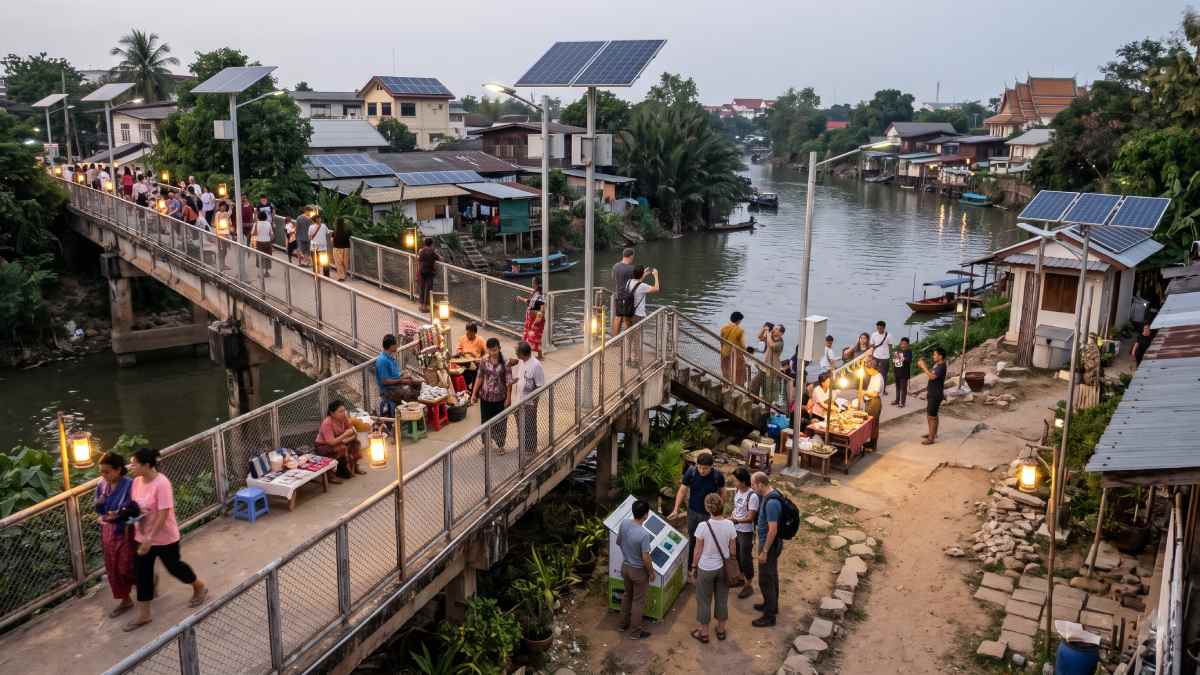
This adaptive engineering approach was applied in Laoag City, Philippines, where the Love Lock Bridge in Barangay La Paz was opened by the City Government of Laoag, led by Mayor James Bryan Q. Alcid and supported by the Sangguniang Panlungsod. An existing public bridge crossing the La Paz River near the La Paz Sand Dunes was repurposed, being transformed into an engaging pedestrian walkway and community attraction. Rather than an entirely new crossing being funded, a modular upgrade was executed by city engineers with an approved municipal budget of ₱1.8 million (approximately $31,000 USD).
Structural Retrofit Sequence
- Step 1: Non-Destructive Testing ➔ Core extraction and ultrasonic velocity checks
- Step 2: Chemical Anchor Placement ➔ High-tensile stainless anchors set into the bridge deck
- Step 3: Modular Mesh Integration ➔ Marine-grade 316 stainless mesh fastened to the deck
- Step 4: Off-Grid Lighting Array ➔ Autonomous solar luminaires attached to pilings
The adaptation of existing structures was prioritised through several core phases:
- Non-destructive concrete testing was conducted to verify girder load-bearing capacity.
- Marine-grade 316 stainless steel wire mesh was installed along the parapets to accommodate decorative padlocks without corrosion or structural degradation being caused to the main bridge components.
- Modular crowd-control handrails were securely mounted along pedestrian zones.
- Standalone solar LED fixtures were attached directly to existing pilings, eliminating the requirement for cable trenches to be excavated across approach roads.
An underutilised civil asset was successfully converted into a secure, functional tourism destination at roughly two percent of the cost that would have been required to construct a new pedestrian bridge.
Operational Frameworks: Hyper-Local Governance and Devolution
Post-opening deterioration is frequently observed as a recurring issue in secondary-city public investments. When distant public assets are managed by centralised municipal agencies overseeing broad administrative areas, maintenance backlogs, broken fixtures, and neglected facilities are regularly produced.
This problem is addressed in decentralised micro-infrastructure by transferring daily management to hyper-local bodies, such as Barangay Councils in the Philippines, Village Development Committees in South Asia, or Kelompok Sadar Wisata (Pokdarwis) in Indonesia.
Devolving Asset Stewardship to Community Councils
In the case of Laoag City’s Love Lock Bridge, a formal handover plan was instituted by the municipal government, through which ongoing operational management was assigned to Barangay La Paz. Direct responsibility for site security, public order, and regular sanitation was assumed by the barangay.
Accountability is generated through this local oversight: evening visitor footfall directly benefits the neighbourhood council, while small commercial stalls selling custom locks, food, and crafts to travelers are operated by local residents. A share of vendor fees is deposited into a dedicated local maintenance fund, allowing minor repairs, cleaning supplies, and security costs to be met without demands being placed on the central municipal treasury.
A regional benchmark for this strategy was established by Nglanggeran Tourism Village in Gunung Kidul, Yogyakarta, Indonesia. Rather than day-to-day oversight of the ancient volcano site being retained by the central government, management was devolved to a village board operated by local youth and community members. Entry access, visitor limits, and the maintenance of walking trails and observation decks were supervised by the board. Outstanding performance across economic, social, and environmental sustainability metrics was achieved, resulting in Nglanggeran being recognised as a UNWTO Best Tourism Village in 2021.
A similar community-led structure was implemented in the northern highlands of Sa Pa, Vietnam, within ethnic minority villages such as Ta Phin. Stone-paved walking paths and scenic lookout platforms were overseen by local H’mong and Red Dao councils. In accordance with the ASEAN Community-Based Tourism Standard, a percentage of homestay fees and trekking permits was directed into community infrastructure accounts by the hamlets. Path repairs, timber railing upkeep, and waste collection were sustained by these funds, proving that rural public assets can be maintained and local heritage protected under community governance.
Establishing Self-Sustaining Micro-Concession Revenues
Reliable revenue streams that operate independently of municipal funding allocations are required to ensure the lasting financial viability of devolved micro-infrastructure. Tourist foot traffic is converted into sustained local funding through the micro-concession framework:
- Direct Household Revenue: Between 85 and 90 percent of vendor earnings are retained by local families vending artisanal goods, regional foods, or specialized services.
- The Upkeep Levy: A mandatory 10 to 15 percent concession contribution is remitted into a segregated village sinking fund.
- Ring-Fenced Expenditure: Routine sanitation, solar battery maintenance, and minor structural repairs are financed directly from dedicated funds without administrative delays being encountered.
Through this financial mechanism, funding allocations for asset maintenance are expanded in tandem with increases in visitor footfall, preventing maintenance deficits from accumulating.
Economic Mechanics: Capital Expenditure vs. High-Yield Placemaking
The financial viability of public placemaking projects is governed by the relationship between initial capital deployment and long-term operating commitments. Long design, procurement, and construction phases are entailed by capital-heavy investments, yielding zero community return for years while substantial debt service obligations are accumulated.
Conversely, rapid project execution is achieved through decentralised micro-infrastructure, immediate economic support is extended to informal enterprises, and local balance sheets remain unencumbered by ongoing liabilities.
Comparative Project Evaluation Metric
| Project Evaluation Metric | Centralised Mega-Attraction | Decentralised Micro-Placemaking Asset | Analytical Assessment |
| Capital Outlay (CapEx) | $5,000,000 – $50,000,000+ | $15,000 – $50,000 | Funded via small discretionary ward or barangay accounts without municipal debt being incurred. |
| Operational Costs (OpEx) | High (central grid draw, mechanical upkeep, specialised staff) | Negligible (self-contained solar power, community maintenance) | Utility costs are eliminated from municipal balance sheets. |
| Development Horizon | 3 to 8 Years | 6 to 12 Weeks | Fully functional public assets are delivered within a single fiscal cycle. |
| Environmental Impact | Substantial (deep foundations, extensive paving, habitat disruption) | Minimal (modular additions to existing concrete and steel spans) | River corridors and scenic vistas are preserved without additional impervious ground cover being introduced. |
| Promotional Dynamic | Paid media (advertising buys, PR retainers, sponsored placement) | Organic (user-generated content driven by interactive visitor rituals) | Visitors are transformed into active brand advocates through digital content sharing. |
| Asset Stewardship | Corporate concessionaires or central state departments | Neighbourhood councils and local merchant cooperatives | Site deterioration and vandalism are curtailed through continuous local presence. |
| Local Revenue Capture | Limited (major shares return to central or foreign operators) | High (vendors and micro-enterprises retain direct customer spend) | Steady income streams are channelled directly to domestic food vendors, guides, and artisans. |
The operational viability of these public assets is evaluated using the municipal operating ratio, defined as total operating expenses divided by gross direct and indirect municipal revenues. Operating ratios between 0.70 and 0.95 are frequently exhibited by large centralised public facilities, indicating that nearly all incoming receipts are consumed by power consumption, facility servicing, and administrative payroll. Conversely, direct operating ratios are driven near zero in decentralised installations powered by standalone solar units and maintained by community councils. Broader economic returns are captured across the surrounding locality, elevating revenues for neighborhood eateries, transit operators, and family-owned enterprises.
Emotional Placemaking and Organic Digital Discovery
Visual prominence is heavily relied upon for the commercial success of secondary destinations. Substantial outlays on media acquisitions, travel trade expositions, and public relations retainers are required in conventional promotional models. In contrast, paid campaigns are replaced in low-cost placemaking by emotional design, where public spaces are structured around participatory activities that encourage travelers to capture and organically distribute media across digital networks.
In Laoag City, this symbolic engagement was incorporated into the Love Lock Bridge. It was conceived as an accessible site where personal relationships, familial milestones, and commemorative occasions could be honoured, with the attachment of padlocks to the steel mesh acting as a lasting physical gesture.
During the inauguration, the symbolic function was underscored by Vice Mayor Carlos Fariñas, and an invitation was extended to residents and tourists to affix their own locks. Passive pedestrian footfall was successfully converted into engaged participation, motivating visitors to distribute photographs and recordings across online platforms, through which organic discovery for the municipality was stimulated.
Comparable outcomes have been recorded across East and Southeast Asia:
- Jeonju Hanok Village, South Korea: Historic pedestrian corridors within the heritage village—encompassing over 800 preserved traditional Korean structures—were revitalised through an evening illumination initiative led by Director Heo Gap-su of the Hanok Village Support Division. Traditional Cheongsachorong lanterns and low-voltage architectural lighting were deployed along Taejo-ro and adjoining corridors. Dark blind spots were removed and the architectural outlines of traditional tiled eaves were highlighted, extending visitor dwell time well into the night. Substantial organic visibility was generated across digital platforms, providing economic stimulus to nighttime walking tours and merchants at the Nambu Night Market without heavy civil modifications being required.
- George Town, Penang, Malaysia: A series of street murals and interactive wire sculptures was commissioned across the UNESCO World Heritage district by heritage authorities in 2012. Quiet residential lanes were converted into internationally celebrated landmarks through this modest municipal expenditure. Streets were explored on foot and photographic interactions with the installations were widely circulated, establishing the city as an internationally recognised cultural destination with minimal capital expenditure.
Risk Mitigation and Engineering Compliance Protocols
Distinct engineering challenges are introduced when utilitarian civil infrastructure is transformed into high-density pedestrian public spaces. Stress conditions that differ substantially from original engineering assumptions are encountered when structures planned for vehicular transit or service utilities are adapted for public gatherings. Elevated structural stresses can be induced by dense assembly loads, dynamic vibrations during public festivities, and sustained dead loads accumulated from decorative metal fixtures. Systematic safety protocols that combine thorough preliminary load audits with continuous structural monitoring are required to address these vulnerabilities.
Inter-Agency Load Auditing and Structural Certification
Prior to public commissioning, multi-agency inspections were executed for the Laoag City Love Lock Bridge in collaboration with the Department of Public Works and Highways First District Engineering Office and the Laoag City Engineering Office. Structural evaluations of the bridge deck, abutment interfaces, and reinforced concrete pilings were conducted by qualified structural engineers to determine safe crowd allowances. Modular protective handrails, high-tensile wire backstops, and autonomous solar light units were subsequently installed, resulting in a certified public amenity capable of resisting severe typhoon winds and peak holiday loading.
Structural capacity was certified to ensure that combined dead loads (encompassing structural additions, fixtures, and the accumulated weight of decorative padlocks) and live pedestrian occupancy remained well below safety thresholds designated by national bridge engineering standards. Live load allowances were regulated using nominal crowd mass estimates and dynamic amplification factors to account for synchronized pedestrian movement, while density restrictions were imposed to mitigate overcrowding hazards.
Dynamic Crowd Capacity and Environmental Risk Controls
Structural integrity and pedestrian safety are preserved over the lifecycle of the installation by adhering to four standard operating safeguards:
- Standardised Live-Load Ratings: Bridge load tests are systematically executed to verify that retrofitted decks can safely support peak crowd volumes during festivals and holiday weekends.
- Secure Modular Connections: Protective mesh barriers and pedestrian balustrades are secured via chemical anchors affixed directly into primary structural girders, preventing anchoring into degraded concrete or secondary parapets.
- Active Crowd Management: Maximum occupancy limits are designated, trained community wardens are stationed on site during peak intervals, and advisory notices are displayed to prevent localized clustering.
- Weather and Hydrological Monitoring: Mandatory evacuation and bridge closure procedures are triggered whenever elevated water-level sensor telemetry or meteorological advisories signal river surges or typhoon hazards.
An operational precedent for this protocol is observed along the Ping River in Chiang Mai, Thailand. During seasonal flood conditions and cultural celebrations such as Yi Peng and Loy Krathong, pedestrian traffic across spans such as Nawarat Bridge and Saphan Lek (the Iron Bridge) is closely supervised. Periodic structural audits of waterfront walkways, footbridges, and floating docks are coordinated by the Chiang Mai Municipality, the Marine Department, and regional hydrology monitoring centres. Telemetry from hydrological sensor networks (including Station P.1 at Nawarat Bridge) is monitored, waterborne debris accumulations are cleared, and pedestrian flow restrictions are enforced, safeguarding large public assemblies while preserving the cultural connectivity of the riverfront.
Policy Implications and the Future Horizon for Regional Destinations
A fundamental reorientation in municipal tourism development is demonstrated by the proven performance of decentralised micro-infrastructure across secondary Asian cities. As national urban frameworks place heightened priority on fiscal balance, carbon abatement, and inclusive community prosperity, traditional capital investment paradigms are being reassessed by municipal authorities and destination management bodies. Rather than speculative megaprojects being pursued to the detriment of local finances, it is being recognised that durable visitor appeal can be cultivated through targeted, small-scale infrastructural enhancements.
Integrated Policy Implementation Blueprint
- Identify Functional Civil Assets
- Run Structural Audits
- Mount Autonomous Solar Systems
- Devolve Daily Management
- Cultivate Shared Civic Rituals
Four primary policy recommendations are derived for destination planners and urban administrators from the initiatives examined in Laoag City, Ladakh, Yogyakarta, Sa Pa, Jeonju, and Pulau Ubin:
- Prioritise OpEx-Neutral Energy Systems: Standalone photovoltaic generation and integrated battery storage should be mandated for pedestrian corridors, lighting enhancements, and public recreational installations, shielding municipal accounts from escalating utility overheads.
- Anchor Assets in Hyper-Local Management: Formal governance agreements should be integrated from project inception, transferring routine upkeep, sanitation, and site surveillance to ward councils and local merchant associations to cultivate local pride and custodial responsibility.
- Repurpose Existing Infrastructure First: Comprehensive inventories of existing public works—such as underutilised crossings, flood revetments, and historic alleys—should be evaluated prior to capital allocations for ground-up developments, conserving public capital while celebrating indigenous spatial identity.
- Embed Structural Safety Early: Rigorous engineering discipline must be upheld throughout frugal placemaking initiatives. Independent load evaluations and safety certifications must be embedded into initial project phases in coordination with public works departments to guarantee long-term safety and public confidence.
A robust and sustainable development paradigm is offered to secondary cities through decentralised micro-infrastructure. When sound civil engineering is integrated with renewable utility systems and empowered neighbourhood governance, functional public assets can be successfully converted into enduring, self-sustaining destinations that provide long-term enrichment for their communities.
Conclusion
It has been shown time and time again by secondary cities across Asia that a transforming tourist economy is possible without the need for debt-ridden vanity projects and impractical public support systems. Utilitarian civil structures are transformed effectively into lively, culturally rich tourist centers through the implementation of decentralized micro-infrastructure. Self-reliance is achieved and genuine civic pride is developed through the combined use of off-the-grid solar energy engineering, strict structural safety standards, and decentralized local management. As regional tourist destinations look for cost-effective and eco-friendly ways of developing their night-time economy, there exists a proven long-term operational model in this placemaking process, where municipal sustainability thrives as low capital investment works alongside engineering and local authenticity.
The post Laoag Along with Jeonju and Other Towns Transform Asia’s Tourism Future With Solar-Powered, Low-Cost Urban Placemaking appeared first on Travel and Tour World




































































