








Japan’s Tax-Free Shopping Rules 2026: Complete Guide to the New Refund System for Tourists
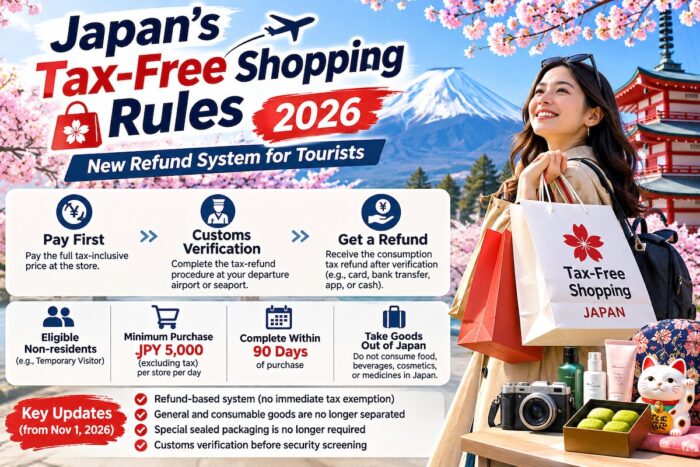
Japan’s Tax-Free Shopping Rules
-
Travel, Health, Food, Currency
-
-
26 mins
-
Out of Town Blog
-
Melo Villareal
-


Japan Tax-Free Shopping Guide: New Refund Rules, Eligibility, Procedures, and Travel Tips Japan remains one of the world’s most popular shopping destinations, attracting international visitors looking for electronics, cosmetics, skincare products, Japanese fashion, luxury goods, souvenirs, snacks, and specialty merchandise. For many travelers, tax-free shopping is an effective way to save money when purchasing products […]
Japan’s Tax-Free Shopping Rules 2026: Complete Guide to the New Refund System for Tourists
Japan Tax-Free Shopping Guide: New Refund Rules, Eligibility, Procedures, and Travel Tips
Japan remains one of the world’s most popular shopping destinations, attracting international visitors looking for electronics, cosmetics, skincare products, Japanese fashion, luxury goods, souvenirs, snacks, and specialty merchandise. For many travelers, tax-free shopping is an effective way to save money when purchasing products to bring home.
Japan’s Tax-Free Shopping Rules
However, Japan introduced a major change to its consumption tax exemption program on November 1, 2026. The country replaced its previous point-of-sale tax exemption system with a refund-based system, changing how tourists pay for purchases and receive their tax savings.
Under the previous arrangement, eligible visitors could purchase qualifying products without paying consumption tax at participating stores or receive an immediate tax refund at designated counters. Under the new system, shoppers initially pay the full tax-inclusive price. They then complete customs verification when leaving Japan before receiving a refund equivalent to the consumption tax.
This change affects tourists shopping at department stores, drugstores, electronics retailers, luxury boutiques, shopping malls, outlet centers, and other participating establishments.
Understanding the new rules is essential before planning a shopping trip to Tokyo, Osaka, Kyoto, Fukuoka, Sapporo, or other Japanese destinations. Travelers must also understand eligibility requirements, minimum spending thresholds, refund methods, customs procedures, and restrictions on using purchased goods before departure.
This guide explains Japan’s tax-free shopping regulations in 2026, compares the old and new systems, and provides practical instructions to help international tourists complete their purchases and refunds successfully.
1. Understanding Japan’s New Tax-Free Shopping System in 2026
Japan’s consumption tax exemption program allows eligible non-resident visitors to purchase qualifying merchandise for export without ultimately bearing the Japanese consumption tax.
The major change took effect on November 1, 2026, when Japan adopted a refund-based system.
Under the revised arrangement, tourists must pay the regular tax-inclusive retail price when purchasing eligible merchandise. The consumption tax equivalent is refunded after customs confirms the goods are leaving Japan.
Japan Customs and the Japan Tourism Agency administer the procedures governing this arrangement. Individual participating retailers or their authorized refund providers handle the actual refund payments.
How the new system works
The new process follows three main stages:
- Purchase: Visit a participating tax-free shop, present the required identification, and purchase eligible merchandise at the regular tax-inclusive price. Register the refund method specified by the store.
- Customs verification: Before leaving Japan, present your passport at the designated tax-refund kiosk or electronic terminal at your departure airport or seaport. Customs may require you to present the actual merchandise.
- Tax refund: Once customs confirms that the purchases are being exported, the retailer or its refund provider processes the consumption tax refund using your registered payment method.
The important difference is that tourists no longer receive the tax savings immediately at checkout. They must complete the departure procedures before the refund becomes payable.
Old system versus new refund system
| Shopping requirement | Old system (until October 31, 2026) | New system (from November 1, 2026) |
|---|---|---|
| Payment at checkout | Tax-exempt price or counter-based refund | Full tax-inclusive price |
| Refund timing | Immediate exemption or refund | After customs verification |
| Customs inspection | Generally after security screening | Before security screening |
| Customs procedure | Passport and purchase records | Passport and possible physical inspection |
| Refund method | Immediate tax exemption or counter refund | Card, bank transfer, app, or cash where offered |
| General and consumable goods | Separate categories | Category distinction abolished |
| Special sealed packaging | Required for certain consumables | No longer required |
| Departure deadline | Previous export confirmation rules | Customs confirmation within 90 days of purchase |
What happens to the old tax-free shopping rules?
Several requirements under the previous system have been removed or changed.
- The distinction between general merchandise and consumable goods has been abolished.
- Special sealed packaging for consumable products is no longer required.
- The previous JPY 500,000 purchase ceiling for consumables has been removed.
- Travelers must still take all qualifying purchases out of Japan.
- Consuming food, beverages, cosmetics, medicines, and other consumable goods in Japan prevents the corresponding refund.
- Purchases must remain available for customs verification when requested.
These changes simplify the shopping process, but tourists must still follow the export requirements.
2. Who Is Eligible for Tax-Free Shopping in Japan?
Not every international visitor automatically qualifies for tax-free shopping. Japan’s system is intended primarily for eligible non-residents who purchase merchandise for export.
Your immigration status, residency, length of stay, and supporting identification determine whether you can participate.
Foreign tourists with Temporary Visitor status
Foreign nationals entering Japan as Temporary Visitors are generally eligible if they meet the non-resident requirements.
This category includes many international tourists visiting Japan for sightseeing, shopping, leisure, and short business-related activities that qualify under their immigration status.
You must generally purchase the goods within six months of entering Japan.
The immigration landing permission information in your passport is important because participating retailers use it to verify your eligibility.
Diplomats and government officials
Foreign nationals entering Japan under Diplomat or Official status may qualify for tax-free purchases.
These categories are subject to special eligibility provisions. They should present the appropriate passport and supporting immigration documentation when requested.
Unlike ordinary Temporary Visitors, these categories are excluded from the usual six-month entry restriction under the eligibility provisions.
Foreign residents living in Japan
Foreign nationals who ordinarily reside in Japan are generally not eligible for tax-free shopping.
This includes many people holding residence statuses associated with employment, education, family residence, and long-term stays.
For example:
- International students studying at Japanese universities generally cannot claim tourist tax refunds.
- Foreign employees working in Japan are generally ineligible.
- Foreign nationals holding long-term resident status cannot automatically qualify simply because they hold a foreign passport.
- Foreigners who have established residence in Japan are generally excluded.
The key distinction is residency, not nationality alone.
Japanese citizens living overseas
Japanese nationals who have lived outside Japan continuously for at least two years may qualify when temporarily returning to Japan.
They must also meet the requirement that their temporary return lasts less than six months.
The required documents include:
- Japanese passport.
- Certificate of Residence Abroad (Zairy? Sh?meisho).
- Copy of the Supplementary Family Register (Koseki no Fuhy?).
- An eligible My Number Card showing the overseas transfer record.
Japanese citizens should verify that their documents establish the required overseas residency period before shopping.
Cruise ship passengers
International cruise passengers may qualify under Japan’s Cruise Ship Tourist Landing Permission.
They should present their passport and cruise ship landing permission document when completing tax-free shopping procedures. A passport copy may be accepted under the special cruise passenger provisions.
The purchase and departure procedures depend on the cruise itinerary and the port from which the passenger finally leaves Japan.
Other special categories
Other potentially eligible categories include:
- Transit landing permission holders.
- Port-of-call landing permission holders.
- Certain United States military personnel entering under the Japan-U.S. Status of Forces Agreement.
- Eligible crew members.
- Emergency landing permission holders.
- Individuals granted landing permission due to distress.
- Certain qualifying registered travelers under Japan’s Trusted Traveler Program.
These categories have specific document requirements. Travelers should confirm their eligibility with the retailer before making purchases.
3. Required Documents for Tax-Free Shopping
Your passport is the most important document when shopping under Japan’s tax-free program.
Eligible international tourists should carry their original passport rather than relying on a photocopy or photograph.
Retailers need to verify your immigration status and submit the necessary purchase information.
| Traveler category | Documents to prepare |
|---|---|
| Foreign tourist | Original passport with landing permission information |
| Diplomat | Passport and applicable diplomatic documentation |
| Government official | Passport and applicable official documentation |
| Cruise passenger | Passport and cruise ship landing permission |
| Crew member | Passport and crew landing permission |
| Japanese national living overseas | Japanese passport and accepted overseas residency documentation |
| Qualifying registered traveler | Passport and applicable registered traveler documentation |
For Japanese citizens returning from overseas, the accepted residency evidence includes a qualifying My Number Card, Certificate of Residence Abroad, or Supplementary Family Register.
Practical tip: Complete your immigration procedures properly upon arrival and make sure your landing permission information is available. Missing documentation can prevent retailers from processing eligible tax-free purchases.
4. Minimum Purchase Requirements and Tax Refund Thresholds
Japan maintains a minimum spending requirement for tax-free purchases.
Under the refund system effective November 1, 2026, eligible purchases must total at least JPY 5,000 excluding consumption tax per store per day.
This requirement applies to the combined eligible merchandise purchased by the same shopper at the same participating store on the same day.
How much do you need to spend?
| Consumption tax rate | Minimum purchase before tax | Minimum amount including tax |
|---|---|---|
| Standard rate: 10% | JPY 5,000 | JPY 5,500 |
| Reduced rate: 8% | JPY 5,000 | JPY 5,400 |
Japan generally applies a 10% consumption tax to most merchandise. Certain qualifying food and beverage purchases are subject to the reduced 8% rate.
For mixed purchases, the eligible tax-exclusive amounts are used to determine whether the minimum threshold has been reached.
Can you combine purchases from different stores?
Generally, you cannot combine purchases from separate stores to meet the minimum spending requirement.
However, an exception applies when participating retailers entrust their tax-free procedures to a common authorized counter. In this situation, purchases from multiple participating stores may be combined under the counter’s arrangements.
Ask the shopping center or department store whether it offers consolidated tax-free processing.
Can family members combine their purchases?
No. The minimum spending requirement applies to each eligible purchaser individually.
For example, if two family members each purchase JPY 3,000 worth of eligible merchandise, they cannot combine their purchases to reach the JPY 5,000 threshold.
Each shopper must complete the procedure using their own qualifying identification.
Can you combine morning and afternoon purchases?
Yes, provided the purchases are made by the same eligible shopper at the same participating store on the same calendar day and satisfy the retailer’s processing requirements.
This is useful when you want to purchase additional merchandise from the same retailer later in the day.
5. Which Products Qualify for Tax-Free Shopping?
Japan’s revised system simplifies how eligible merchandise is classified.
Previously, retailers distinguished between general merchandise and consumable products. From November 1, 2026, this distinction has been abolished for the tax-free shopping procedure.
The main requirement is that the merchandise must qualify for export and be taken out of Japan by the purchaser.
Common eligible purchases
Electronics and gadgets
Examples include:
- Smartphones and tablets.
- Digital cameras and lenses.
- Headphones and audio equipment.
- Gaming consoles and accessories.
- Computers and electronic accessories.
- Small household appliances.
Fashion and luxury merchandise
Examples include:
- Clothing and footwear.
- Designer handbags.
- Watches and jewelry.
- Fashion accessories.
- Japanese fashion brands.
- Premium leather products.
Cosmetics, skincare, and personal care
Examples include:
- Japanese skincare products.
- Facial cleansers and moisturizers.
- Makeup and beauty products.
- Haircare products.
- Beauty devices.
- Personal care merchandise.
Food, beverages, and souvenirs
Examples include:
- Japanese snacks and confectionery.
- Packaged sweets.
- Matcha products.
- Packaged tea and coffee.
- Regional food souvenirs.
- Packaged beverages.
These products can qualify, but they must remain unused or unconsumed in Japan and be taken out of the country.
What products are excluded?
Certain purchases do not qualify under the tax-free shopping program.
These include:
- Gold and platinum bullion.
- Gold and platinum coins.
- Products that are already exempt from consumption tax.
- Services and expenses that are not eligible merchandise.
- Items purchased for commercial or resale purposes.
The quantity must also be reasonable for personal export. Customs may question purchases that the individual traveler cannot reasonably carry out of Japan.
6. Can You Use Tax-Free Purchases While Staying in Japan?
This is one of the most important changes tourists should understand.Under the new system,
Japan no longer requires special sealed packaging for consumable products. However, removing the packaging requirement does not mean that travelers can freely consume their tax-free purchases before departure.
Food and beverages
If you purchase Japanese snacks, chocolates, instant noodles, bottled drinks, or other food products under the tax-free program, you must take them out of Japan.
Eating or drinking these products during your stay makes the corresponding purchase ineligible for the tax refund.
Cosmetics and skincare
Cosmetics and skincare products are also subject to export requirements.
Avoid opening or using products purchased under the tax-free program while in Japan.
For example, buying a Japanese sunscreen, moisturizer, or facial serum and using it during your holiday can make that purchase ineligible for customs confirmation.
Clothing and electronics
General merchandise is treated differently from consumables.
You may generally use clothing, footwear, and electronic products during your stay, provided the merchandise is ultimately taken out of Japan.
For example, wearing a jacket purchased in Tokyo or using a camera bought in Osaka does not automatically disqualify it from the tax refund.
However, you must still have the goods available for customs inspection if requested.
What if you consume only one item from a receipt?
This is particularly important under the revised system.
Customs verification is performed per purchase transaction, such as an individual receipt. If one item included in a particular transaction is missing because it was consumed or is no longer in your possession, the other goods on that same transaction may also become ineligible for the refund.
If you have consumed any part of a consumable purchase, do not proceed as though the entire transaction remains eligible. Inform customs staff about the situation.
Separate purchases recorded on different transactions are assessed separately.
7. Where Can You Shop Tax-Free in Japan?
International tourists can find participating tax-free stores in major Japanese shopping districts, department stores, commercial centers, and tourist destinations.
However, not every branch of a familiar retail chain necessarily participates. Confirm that the specific location supports the new refund system before completing your purchase.
Department stores
Department stores are popular destinations for fashion, cosmetics, jewelry, watches, home goods, and Japanese souvenirs.
Examples include Isetan, Mitsukoshi, Takashimaya, and Daimaru.
Some department stores operate centralized tax-free counters, allowing shoppers to process qualifying purchases from participating tenants through a common facility.
Ask whether the new refund method is supported and whether a processing fee applies.
Drugstores and cosmetics shops
Drugstores are popular among tourists purchasing Japanese skincare, makeup, beauty products, personal care merchandise, and packaged health products.
Matsumoto Kiyoshi and other Japanese drugstore chains have stores in major shopping districts.
Remember that cosmetics and other tax-free consumables must remain unused and be exported.
Electronics retailers
Electronics stores offer cameras, computers, gaming products, smartphones, appliances, and accessories.
Bic Camera and Yodobashi Camera are familiar shopping destinations in major cities.
Before making expensive purchases, ask the retailer about refund arrangements, warranty coverage, and whether the product can be presented easily at customs.
Discount stores and convenience stores
Discount retailers such as Don Quijote are popular with tourists purchasing snacks, cosmetics, household items, souvenirs, and novelty merchandise.
Some convenience stores also offer tax-free shopping services at participating branches.
Check the branch’s participation and refund arrangements before assuming that every store offers the same service.
Outlet malls and shopping streets
Outlet malls and shopping streets are useful destinations for clothing, footwear, accessories, and branded merchandise.
Popular shopping destinations include Gotemba Premium Outlets, Rinku Premium Outlets, and Shinsaibashi in Osaka.
Remember that the tax-free minimum applies to eligible purchases under the same retailer’s arrangements. Purchases from unrelated stores generally cannot be combined.
Shopping tip: Before visiting a store, look for the tax-free shop sign and ask whether the branch supports the refund method introduced in November 2026.
8. How to Claim a Tax Refund in Japan: Step-by-Step Guide
The new system requires tourists to complete the refund process in three stages.
Step 1: Visit a participating tax-free shop
Look for a store participating in Japan’s tax-free shopping program.
Before purchasing, confirm that the merchandise qualifies and that your total spending reaches the minimum threshold.
Ask the cashier about the refund arrangements, including whether you need to register a credit card, bank account, or mobile payment account.
Step 2: Present your passport
Show your original passport and allow the retailer to verify your eligibility.
The store will record the required purchase information and explain the refund process.
Eligible Japanese nationals returning from overseas and travelers under special landing permissions must present additional supporting documents.
Step 3: Pay the tax-inclusive price
Unlike the old system, you must pay the regular retail price, including consumption tax.
For example, if eligible merchandise costs JPY 20,000 before tax at the standard 10% rate, you initially pay JPY 22,000.
The tax component is JPY 2,000, which may be refunded after customs verification, subject to the retailer’s applicable refund arrangements and fees.
Step 4: Keep your purchases accessible
Store all tax-free purchases somewhere you can easily retrieve them.
Do not place everything inside checked luggage before completing customs verification.
Separate receipts and organize purchases to make the inspection process easier.
Step 5: Complete customs verification at departure
Before checking in your luggage, proceed to the designated tax-free procedure terminal at your departure airport or seaport.
Scan or present your passport as instructed.
The terminal will indicate whether further inspection is required.
- Green result: Customs verification is complete.
- Red result: Proceed to the designated customs inspection area and present the merchandise for examination.
A green result does not mean that you can ignore the requirement to export your purchases. You must still take the goods out of Japan.
Step 6: Receive your refund
After customs verification, the retailer or its designated refund provider processes the consumption tax refund.
Depending on the shop, you may receive the money by credit card, bank transfer, mobile payment service, or cash refund.
Processing times and applicable service fees depend on the provider.
9. Japan Tax Refund Methods: Credit Cards, Cash, and Electronic Payments
Japan does not require every tax-free retailer to use one standard refund method.
The National Tax Agency recognizes several possible refund arrangements, including bank transfers, credit card transfers, app-based transfers, and cash refunds at the departure port after customs confirmation.
The retailer may manage the refund directly or use an authorized refund service provider.
| Refund method | How it works | What to check |
|---|---|---|
| Credit card | Refund credited through the applicable card arrangement | Eligible cards, currency conversion, processing time |
| Bank transfer | Refund sent to the registered bank account | Account details, transfer fees, supported countries |
| Electronic wallet or app | Refund transferred through a supported payment service | App eligibility, verification, transaction charges |
| Cash refund | Cash collected at a designated refund counter or kiosk | Availability, currency, operating hours |
| Third-party refund provider | Provider processes the refund for participating retailers | Service fees, payment options, processing rules |
Credit card refunds
Credit card refunds can be convenient for international tourists who prefer receiving their money electronically.
However, do not assume that every retailer automatically credits the original card used for payment.
Some stores may require you to register a designated card or follow a separate refund-provider procedure.
Ask whether the refund will be credited in Japanese yen or another currency and whether your bank may apply foreign exchange charges.
Cash refunds
Some participating retailers and refund providers offer cash refunds after customs confirmation.
At certain airports, designated cash refund kiosks may be available for supported refund arrangements. These cash refunds are generally paid in Japanese yen, and not every store offers airport cash collection.
Confirm service availability before leaving the shop.
Electronic wallets and mobile payment services
Certain providers may offer refunds through supported mobile payment platforms.
Availability depends on the retailer, refund provider, and payment service. Do not assume that all international electronic wallets are accepted.
Refund service fees and processing time
A refund may be lower than the full consumption tax amount because some retailers or refund providers charge service or processing fees.
For example, a JPY 22,000 purchase at the standard 10% tax rate includes JPY 2,000 in consumption tax. If the refund provider charges a fee, you may receive less than JPY 2,000.
Japan does not impose one universal refund processing time or service fee across all retailers.
Before completing a purchase, ask:
- Is there a refund processing fee?
- Will the refund be issued after customs confirmation?
- Is cash collection available at the departure airport?
- How long does an electronic refund normally take?
- Does the refund provider support my credit card or bank account?
- Will the refund be issued in Japanese yen or another currency?
This is particularly important when making expensive purchases at luxury boutiques, electronics stores, and department stores.
10. Airport and Seaport Customs Procedures
One of the biggest changes under the new system is when customs verification happens.
Under the previous system, customs checks generally took place after security screening. Under the new system, tourists must complete the required verification before passing through security.
This means that you must plan your airport arrival carefully.
Major international airports covered by the system
Japan Customs provides tax-refund procedures at international airports and designated seaports.
The following seven airports also support the Visit Japan Web online procedure:
| Airport | Location |
|---|---|
| Narita International Airport | Chiba Prefecture |
| Haneda Airport | Tokyo |
| Kansai International Airport | Osaka Prefecture |
| Chubu Centrair International Airport | Aichi Prefecture |
| Fukuoka Airport | Fukuoka |
| New Chitose Airport | Hokkaido |
| Naha Airport | Okinawa |
At these airports, travelers can use either the designated tax-refund kiosk or the supported Visit Japan Web online procedure.
What about international seaports?
Cruise passengers departing from Japan must also complete customs verification.
Japan Customs provides procedures at designated seaports, with terminal locations and inspection arrangements varying by port.
Passengers should check the relevant port’s customs information before departure.
For international cruises that depart from and return to a port outside Japan, passengers must complete the procedure at the final Japanese port before leaving the country.
For fly-and-cruise itineraries, where passengers take a cruise that visits overseas ports before returning to Japan and then fly home, they complete the procedures for the stay at the final departure airport.
What about connecting flights?
Travelers connecting from a domestic Japanese flight to an international flight should complete customs verification at the airport where they finally leave Japan.
For example, a passenger flying from Sapporo to Tokyo before connecting to an international flight to Manila should complete the tax-refund procedure at Haneda or Narita, depending on the international departure airport.
Allow enough time for the connection and customs inspection.
11. Using Visit Japan Web for Tax Refund Procedures
Visit Japan Web is a Japanese government digital service that supports various entry and departure procedures.
Under the new tax-refund system, eligible travelers can also use it for online customs confirmation at seven designated international airports.
Who can use Visit Japan Web for tax refunds?
The online refund procedure is available to eligible travelers holding these statuses:
- Temporary Visitor.
- Diplomat.
- Official.
Japanese nationals cannot use this particular online customs verification option.
Travelers outside these categories should use the designated tax-refund terminal or follow the instructions provided by customs.
How to use Visit Japan Web
- Register for Visit Japan Web and complete the required traveler information.
- Register the passport facial image and landing permission information required for the tax-free service.
- Before customs verification at departure, connect to the airport’s designated Wi-Fi network.
- Open Visit Japan Web and select the tax refund procedure.
- Review the purchase records displayed.
- Follow the instructions and check the result.
- If the procedure is incomplete or customs requires inspection, proceed to the designated inspection area.
Complete the online procedure in the designated international departure lobby before security screening.
If you cannot complete the process online, use the physical tax-refund kiosk.
Visit Japan Web also offers a Tax-Free 2D Code for participating stores. This is a separate shopping convenience and should not be confused with the online departure customs confirmation procedure. Screenshots of the 2D Code cannot be used in place of the live code.
12. Important Mistakes to Avoid When Shopping Tax-Free in Japan
The new system gives tourists more flexibility in purchasing different types of merchandise, but mistakes can still result in rejected refunds.
Here are common problems to avoid.
1. Forgetting to complete customs verification.
Paying the tax-inclusive price at checkout does not automatically guarantee a refund. You must complete customs verification when departing Japan.
2. Checking in your luggage too early.
Never place tax-free purchases in checked baggage before completing customs procedures. You must have the goods available for inspection.
3. Consuming food and cosmetics purchased tax-free.
Do not eat, drink, or use consumable purchases before leaving Japan. These products must be exported in the condition in which you purchased them.
4. Missing the 90-day departure deadline.
You must obtain customs confirmation within 90 days of the purchase date.
5. Assuming every retailer participates.
Not every branch of a familiar Japanese retail chain offers tax-free shopping. Confirm participation before purchasing.
6. Forgetting to register your refund method.
The refund cannot be processed properly if the required payment information is incomplete or incorrect.
7. Assuming that the refund has no service fee.
Some retailers and refund providers may deduct processing fees. Ask about the final refund amount before purchasing.
8. Combining purchases from unrelated stores.
You generally cannot combine unrelated store purchases to meet the JPY 5,000 minimum.
9. Buying merchandise for resale.
Japan’s tourist tax-free system is intended for personal export purchases, not commercial resale or buying merchandise for another person.
10. Arriving at the airport too late.
A red customs result may require a physical inspection. Give yourself enough time to complete the procedure before boarding.
13. Practical Tax-Free Shopping Tips for International Tourists
A little preparation can make shopping in Japan more convenient and help you avoid unnecessary expenses.
- Carry your original passport whenever you shop.
- Confirm that the retailer supports the new refund system.
- Check the minimum spending requirement before paying.
- Ask about refund service fees and processing times.
- Keep your receipts and purchase records organized.
- Avoid opening consumables purchased under the tax-free program.
- Keep tax-free merchandise accessible during your journey to the airport.
- Check where customs kiosks are located at your departure airport.
- Register for Visit Japan Web in advance if eligible.
- Allow additional time for customs inspection.
- Keep expensive merchandise and its supporting documents accessible.
- Check your refund account or card after departure.
For high-value merchandise, including watches, cameras, and jewelry, keep warranties, certificates of authenticity, and serial-number documentation. Japan Customs may request supporting documents for individual items valued at JPY 1 million or more before tax.
Frequently Asked Questions About Japan’s Tax-Free Shopping Rules
1. Can all foreign tourists enjoy tax-free shopping in Japan?
No. Japan’s tax-free shopping program is available only to eligible non-residents who meet specific immigration and residency requirements. Most foreign tourists entering Japan under Temporary Visitor status qualify if they meet the applicable conditions, including the six-month entry requirement. Foreign nationals who live and work in Japan or study at Japanese educational institutions generally cannot participate. Diplomats, government officials, cruise passengers, and certain other categories may also qualify under special provisions. Always check your immigration status and required documents before shopping.
2. What is the minimum purchase amount for tax-free shopping in Japan in 2026?
The minimum qualifying purchase is JPY 5,000 excluding consumption tax per participating store per day. At the standard 10% tax rate, this means spending at least JPY 5,500 including tax. For eligible merchandise subject to the reduced 8% rate, the equivalent minimum is JPY 5,400. You can generally combine multiple purchases made at the same store on the same day, provided they are recorded under the same eligible purchaser and meet the retailer’s processing requirements.
3. Can I still get an immediate tax refund when shopping in Japan?
Not under the nationwide system introduced on November 1, 2026. Tourists must initially pay the full tax-inclusive retail price at participating stores. The consumption tax equivalent is refunded only after customs verifies that the purchased merchandise is being taken out of the country. Individual retailers may offer different refund arrangements, including cash collection or electronic payments, but these do not remove the requirement for customs confirmation. Always ask the store how its refund process works before completing an expensive transaction.
4. Do I need to keep tax-free purchases sealed when leaving Japan?
No. Japan abolished the special sealed packaging requirement for consumable goods under the new refund system. However, this does not mean you can freely consume or use those purchases during your holiday. You must still take food, beverages, cosmetics, medicines, and other consumables out of Japan. If you consume these products, the corresponding purchases will not qualify for the refund. General merchandise, such as clothing and electronics, may generally be used during your stay if you ultimately export them.
5. Can I use cosmetics, skincare products, and medicines purchased tax-free in Japan?
No, you should not use or consume these products in Japan if you intend to claim the tax refund. Cosmetics, skincare products, medicines, and similar merchandise are subject to export requirements. Although the special sealed packaging requirement has been abolished, the export requirement remains. For example, opening and using a moisturizer purchased tax-free during your Tokyo holiday can make the corresponding transaction ineligible. Keep these products unused and available for customs verification when departing Japan.
6. Can I receive my Japan tax refund through my credit card?
Yes, credit card refunds are among the possible payment methods under Japan’s revised system. However, whether this option is available depends on the retailer and its designated refund provider. Some stores require shoppers to register a specific credit card or provide additional payment information at checkout. The refund may also be subject to processing charges or currency conversion fees imposed by the provider or your bank. Before completing your purchase, ask whether the refund will go to your original payment card or another registered card.
7. How long does it take to receive a tax refund after leaving Japan?
No single processing time applies to every tax-free retailer in Japan. Under the revised system, the refund is generally processed after customs confirms that eligible purchases are leaving the country. Some arrangements may provide cash refunds at designated airport facilities, while card, bank, and electronic wallet refunds may take longer to process. The retailer or refund provider determines the applicable procedure. Before purchasing, ask for an estimated processing period and keep your transaction details until the refund arrives.
8. Can I claim a tax refund at the airport after checking in my luggage?
No. Under the new system, you must complete customs verification before checking in the luggage containing your tax-free purchases. Customs may require you to present the actual merchandise, so you must keep it accessible. The designated terminals are generally located in the international departure area before baggage check-in and security screening. If you have already handed your purchases to the airline, you cannot simply retrieve your checked baggage to complete the tax-refund procedure. Complete customs verification first, then proceed to check in.
9. Can I use Visit Japan Web to claim my tax refund?
Yes, eligible travelers can use Visit Japan Web for online customs confirmation at Narita, Haneda, Kansai, Chubu Centrair, Fukuoka, New Chitose, and Naha airports. The service is available to qualifying travelers holding Temporary Visitor, Diplomat, or Official status. You must complete the required registration and connect to the airport’s designated Wi-Fi network in the international departure area. Japanese nationals cannot use this online customs verification option. If you cannot complete the procedure online, use the physical tax-refund kiosk instead.
10. Can Japanese citizens living overseas enjoy tax-free shopping when visiting Japan?
Yes. Japanese nationals who have continuously maintained an address or residence outside Japan for at least two years may qualify when temporarily returning for less than six months. They must present their Japanese passport and acceptable supporting documentation proving overseas residency. Accepted documents include a Certificate of Residence Abroad, a Supplementary Family Register, or a qualifying My Number Card showing the overseas transfer record. These requirements are particularly important for Japanese expatriates returning home for holidays, family visits, or short stays.
11. What happens if I fail to complete the tax-refund procedure before leaving Japan?
If you do not obtain the required customs confirmation within 90 days of purchasing the merchandise, you will not qualify for the refund under the new system. Paying the full tax-inclusive price at checkout does not automatically make the purchase tax-free. You must also present your passport and make the merchandise available for customs verification when required. Travelers should therefore complete the procedure before checking in their baggage and allow sufficient time for inspection. Do not assume that you can claim the refund after returning home.
12. Can I send my tax-free purchases from Japan directly to my home country?
You should not assume that mailing your purchases home independently will qualify for Japan’s tourist tax-free refund. Since April 1, 2025, the previous arrangement allowing tourists to claim tax-free treatment by sending purchases overseas themselves through international parcels has been discontinued. A separate direct-export arrangement may still be available when the participating retailer organizes the shipment and follows the applicable export procedures. This is different from simply mailing your purchases at a post office. Ask the retailer about its export and tax treatment before making arrangements.
Essential Japan Tax-Free Shopping Checklist for 2026
Before shopping
- Check whether your immigration status qualifies for tax-free shopping.
- Bring your original passport and supporting documents.
- Look for participating tax-free stores.
- Confirm that the store supports the new refund system.
- Check the JPY 5,000 minimum purchase requirement.
- Ask about refund methods, service fees, and processing times.
- Register the required refund payment information.
Before leaving Japan
- Keep all tax-free purchases accessible for customs inspection.
- Do not consume food, beverages, cosmetics, or other consumables purchased tax-free.
- Check where the customs kiosk is located at your departure airport or seaport.
- Complete customs verification within 90 days of purchase.
- Use Visit Japan Web if eligible and departing from a supported airport.
- Complete customs verification before checking in your luggage.
- Check that your refund has been processed using your registered payment method.
Official Sources and References
For the latest regulations, travelers should consult the following Japanese government agencies and official resources. Check retailer-specific refund arrangements directly before making purchases.
- Japan Customs: Tax Exemption (Refund) Program for Foreign Visitors – Official explanation of the new refund system, customs verification, and departure procedures.
- Japan Customs: Customs Procedure Details – Step-by-step instructions for customs verification at airports and seaports.
- Japan Tourism Agency: Tax-Free Shopping System: Refund Method – Official information about the revised rules, purchase requirements, and customs procedures.
- Japan Tourism Agency: Departure and Customs Verification FAQs – Information about airport procedures, baggage requirements, cruise passengers, and inspections.
- Japan Tourism Agency: Refund Method FAQs – Refund registration, refund timing, and cash payment arrangements.
- National Tax Agency: Revision of the Tax-Free Shop System to the Refund Method – Official tax administration guidance on the revised system and refund arrangements.
- Digital Agency: Visit Japan Web – Official digital procedures and online customs verification information.
- Japan National Tourism Organization: Japan’s Tax Exemption – Tourist-oriented explanation of Japan’s consumption tax exemption program.
- Embassy of Japan in the Philippines: Official Embassy Website – Japanese government announcements relevant to Filipino travelers.
Final Travel Advisory
Japan’s shift to a refund-based tax-free shopping system is one of the most significant changes to its tourist shopping program in recent years. Although the revised rules eliminate special sealed packaging and simplify merchandise classification, they introduce a departure procedure every eligible shopper must understand.
The most important change is that tourists must pay the full tax-inclusive price first and complete customs verification before receiving the refund. This makes proper preparation essential, especially when purchasing expensive electronics, designer merchandise, cosmetics, and souvenirs.
For international travelers, confirm eligibility, understand the refund arrangements at participating stores, keep all purchases accessible, and arrive at the airport or seaport early enough to complete customs verification.
With the right preparation, you can continue enjoying Japan’s shopping destinations while making the most of the country’s tax-free shopping benefits.
Follow and subscribe to OutofTownBlog.com on Facebook, Twitter, Instagram, Pinterest, and YouTube for more Travel-related updates.
Read:
-
- Osaka Museum of History: Explore the Rich Cultural Heritage of Osaka
- First Time in Tokyo? 12 Must-Know Tips for First-Time Visitors to Tokyo
- The Ultimate List of the Best Osaka Luxury Hotels
- Ultimate List of The Best Hotels and Resorts in Osaka, Japan
- First Time in Osaka? 12 Essential Tips for First-Timers in Osaka, Japan
- 15 Best Hotels Near Universal Studios Japan
Japan’s Tax-Free Shopping Rules 2026: Complete Guide to the New Refund System for Tourists
The post Japan’s Tax-Free Shopping Rules 2026: Complete Guide to the New Refund System for Tourists appeared first on Out of Town Blog












































































