
















United States Connects With Ukraine, Belgium and More as Seven Strategic Media Hubs Push Journalist Travel to New Frontiers in 2026
-
Travel, Health, Weather
-
-
10 mins
-
Travel and Tour World
-
Susmita Das
-


United States, Ukraine, Israel, Belgium, Taiwan, Kenya and Switzerland drive journalist travel through diplomacy, conflict, technology and global events
The United States, Ukraine, Israel and the Palestinian territories, Belgium, Taiwan, Kenya and Switzerland are emerging in 2026 as seven of the world’s most important hubs for international journalist travel, with reporters moving between New York, Washington, Kyiv, Jerusalem, Tel Aviv, Brussels, Taipei, Nairobi and Geneva to cover diplomacy, wars, security, technology, trade, humanitarian emergencies and global institutions. Their importance extends far beyond the media industry. Each reporting deployment can generate demand for flights, rail journeys, hotels, serviced accommodation, ground transport, communications support and specialist travel management, creating a small but highly valuable segment of international business travel.
No international authority publishes a complete global table counting every cross-border journalist journey. It would therefore be misleading to claim that an official organisation ranks these destinations exactly from first to seventh by annual journalist arrivals. What can be measured is the extraordinary concentration of foreign press infrastructure, institutional accreditation, permanent correspondents, international meetings and major news events found in these locations.
The picture in 2026 is striking. The United Nations maintained dedicated media accreditation for its high-level General Assembly period in New York. Brussels continues to operate one of the world’s most established international press ecosystems around the European Union and NATO. Geneva has close to 200 correspondents permanently accredited to the United Nations, while Switzerland says International Geneva hosts thousands of meetings every year. Nairobi is expanding as the United Nations’ only headquarters duty station in Africa and the Global South. Taiwan maintains dedicated foreign-media services. Israel has separate accreditation routes for resident and visiting foreign journalists. Ukraine continues to operate a specialised wartime media accreditation system.
Journalist Travel Has Become a Distinct High-Value Business Travel Segment
Journalists do not travel like ordinary tourists. A leisure traveller may book around school holidays, festivals or favourable weather. International news teams travel when events happen. A government announcement, election, summit, military development, humanitarian emergency or diplomatic negotiation can trigger bookings within hours.
That makes media mobility unusually valuable to the travel sector. Journalists frequently need flexible tickets because assignments can be extended or cancelled. Television teams may travel with substantial technical equipment. News agencies may rotate reporters through the same destination. Foreign correspondents may remain abroad for years, while temporary teams may stay for only several days.
The seven destinations examined here illustrate seven different reasons for professional media travel.
| Destination | Major Journalist Travel Driver | Main Reporting Hubs | Typical Press Activity |
|---|---|---|---|
| United States | Global diplomacy, politics, finance and multilateral affairs | New York, Washington, D.C. | UN, White House, Congress, trade and economic reporting |
| Ukraine | War and European security | Kyiv, Kharkiv, Lviv and regional locations | Conflict, defence and humanitarian reporting |
| Israel/Palestinian territories | Middle East crisis and regional security | Jerusalem, Tel Aviv and surrounding areas | Diplomacy, conflict and security coverage |
| Belgium | EU and NATO policy | Brussels | European politics, defence, regulation and trade |
| Taiwan | Technology and East Asian geopolitics | Taipei | Semiconductors, cross-strait affairs and regional politics |
| Kenya | African regional reporting and multilateral affairs | Nairobi | Climate, development, regional security and humanitarian news |
| Switzerland | Diplomacy, human rights, health and peace negotiations | Geneva | UN, humanitarian, health and international policy reporting |
United States Keeps New York and Washington at the Centre of World News
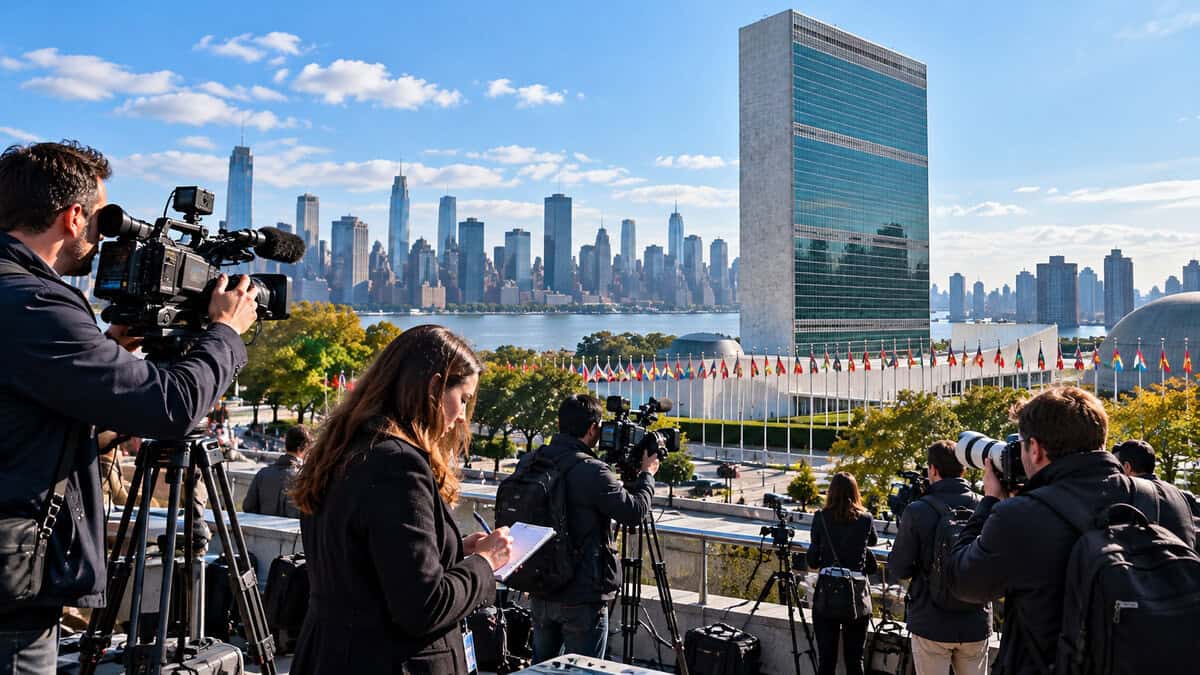
The United States has one of the strongest cases for being considered a global centre of journalist mobility because it combines two extraordinary reporting markets. Washington, D.C. sits at the centre of US federal politics and foreign policy. New York hosts the headquarters of the United Nations and is one of the world’s largest financial and commercial centres.
The US Department of State maintains Foreign Press Centers in Washington, D.C. and New York City, together with a presence on the West Coast. Its updated organisational framework says these centres act as an important point of contact for US-based foreign journalists and process Foreign Press Center credentials for reporters working in the country or attending major summits and other high-profile events. New York experiences a particularly powerful concentration of journalist travel during the United Nations General Assembly.
For the 81st session of the UN General Assembly in 2026, accreditation for the high-level period opened on 1 July and closed on 31 August. The General Debate ran from 22 to 26 September and again on 28 September 2026, while additional high-level meetings covered development, sea-level rise, pandemic preparedness and nuclear disarmament.
The UN operates several media accreditation categories. Temporary accreditation covers visiting journalists working on a particular event or press conference. Long-term correspondent accreditation exists for journalists requiring frequent access. Resident correspondent status is available to a limited number of journalists whose organisations have office or desk space at UN headquarters. The UN says such office space is extremely limited and maintains a waiting list.
That infrastructure shows why New York is more than an occasional event destination for the global press. For airlines and hotels, UN weeks can create concentrated business demand. For serviced apartments and longer-stay providers, permanent foreign correspondents form a different market altogether. Washington creates an additional year-round stream tied to US government policy, global trade, defence, sanctions and international affairs.
Ukraine Creates One of the World’s Most Complex Journalist Mobility Networks
Ukraine represents a dramatically different form of media travel. International journalists continue to enter the country to report on the war, European security, defence developments, civilian conditions, infrastructure and diplomacy. The Ukrainian Ministry of Defence maintains a formal accreditation process for both Ukrainian and foreign media representatives. Applicants seeking an electronic press card must provide identification, documentation connected to their media organisation and other required materials.
The system reflects the risks and operational complexity associated with conflict reporting. Accreditation can be suspended or cancelled when rules applying to work in combat areas are violated. Ukrainian defence authorities also make clear that military and law-enforcement bodies are not responsible for journalists’ personal safety, health, return travel or insurance.
This creates a travel market unlike conventional corporate mobility. News organisations need flexible routing. Journalists may enter through neighbouring European countries before continuing towards Kyiv or other Ukrainian locations. Rail transport becomes particularly important alongside road movement. Equipment, insurance, communications and last-minute itinerary changes are major operational considerations.
Kyiv remains the principal political and international reporting centre, while cities including Kharkiv and Lviv can serve different editorial and logistical needs. The commercial implications reach beyond Ukraine itself. Border and transit hubs in neighbouring European states can also receive journalist traffic connected with reporting deployments.
Israel and the Palestinian Territories Sustain Intense International Media Attention
Israel and the Palestinian territories remain at the centre of sustained international news attention because security events, diplomacy and broader Middle East developments carry consequences far beyond the immediate region. Jerusalem has long been one of the world’s most important foreign-correspondent bases, while Tel Aviv provides another major operational centre for international media.
Israel’s Government Press Office maintains a dedicated Foreign Press Department, providing services to foreign journalists including credentials, permit assistance, work-visa support, entry assistance, professional tours, briefings and press conferences. Its accreditation system recognises the difference between journalists who live and work in Israel and those arriving for temporary assignments.
Regular GPO cards can be granted for periods of up to 12 months to eligible journalists whose permanent work base is Israel. Separate Visiting Journalist GPO cards are issued to eligible foreign journalists arriving for assignments lasting up to three months. That distinction is important for travel and hospitality companies. A permanent international correspondent creates long-term residential and business demand. A visiting television crew can create sudden demand for multiple rooms, vehicles and production facilities. A major security or diplomatic development can cause several news organisations to increase staffing at the same time.
Belgium Turns Brussels Into a Permanent Newsroom for Europe
If Washington represents US political power, Brussels in Belgium represents one of the world’s densest concentrations of international policy reporting. The European Union institutions and NATO operate from the Belgian capital, creating a continuous calendar covering defence, trade, sanctions, climate policy, technology, artificial intelligence, competition law, regulation and international diplomacy.
A major 2026 study by the General Secretariat of the Council examined the changing Brussels press corps and found that the number of accredited journalists had remained roughly stable during the previous five years, even as the number of media organisations operating in Brussels had declined slightly. The research also found that Brussels journalists continue to depend heavily on EU institutional press services, briefings, releases and background information.
That represents an unusually mature international press environment. EU Council accreditation rules require journalists, photographers and television crews to obtain accreditation to enter press areas. A 2026 one-year badge means eligible correspondents do not have to apply individually for every normal event and can access the Council on working days even when major summits are not taking place.
The EU-Western Balkans summit on 25 November 2026 and the Special European Council on 26 and 27 November 2026, for example, require advance registration from media representatives seeking to cover the meetings in person. NATO creates another layer of international press mobility. Journalists regularly covering NATO can apply for annual accreditation, while reporters travelling to headquarters for an individual event can use ad-hoc accreditation. NATO also requires separate event accreditation for certain ministerial meetings, summits and other high-level gatherings.
This means Brussels combines resident correspondents with repeated waves of visiting media. Its transport geography makes the city particularly well positioned. International air services combine with high-speed rail links across Western Europe, enabling reporters to move quickly between major political and commercial centres.
Taiwan Strengthens Taipei’s Position as a Technology and Geopolitical Reporting Hub
Taiwan has become increasingly significant within the international media map. Its importance comes from the intersection of East Asian politics, cross-strait relations, global technology manufacturing and the semiconductor industry. Taipei provides a base for reporters covering Taiwan itself while also serving journalists following wider Asian affairs. Taiwan’s Ministry of Foreign Affairs operates a dedicated Foreign Media Service for overseas journalists stationed in the territory. The ministry provides assistance with press credentials and works with government agencies to facilitate access to information.
The significance of this system lies in Taiwan’s increasingly global news value. Technology journalists follow semiconductor manufacturing and supply chains. Political correspondents monitor cross-strait relations. Business reporters examine trade and investment. Security specialists track developments affecting the wider Indo-Pacific. This mix produces broader travel demand than political coverage alone. Foreign correspondents based in Taipei may need longer-term accommodation, international air access and reliable communications infrastructure. Visiting journalists may arrive for elections, technology events, corporate developments or periods of heightened regional attention.
Switzerland Gives Geneva Extraordinary Global Media Pull
Few cities offer stronger official evidence of international institutional density than Geneva, Switzerland. Swiss government figures published in 2026 show the scale. Around 40 international organisations employing more than 25,000 people are based in Switzerland, mostly in the Lake Geneva region. Approximately 4,000 heads of state, government representatives, ministers and other senior officials travel to Geneva each year for more than 3,500 meetings, according to Switzerland’s Federal Department of Foreign Affairs. More than 175 UN member states are represented there.
A separate 2026 Swiss government overview gives an even broader picture of the Geneva ecosystem: 184 state representations, 43 international organisations, a 32,000-strong international workforce and approximately 6,500 physical, virtual or hybrid conferences annually, attended by more than half a million delegates. Journalism naturally follows that diplomatic activity. The United Nations Office at Geneva says its information service supports close to 200 correspondents from major news agencies and foreign media outlets who are permanently accredited there.
That is one of the clearest measurable indicators of permanent foreign press density among the seven destinations. Geneva’s reporting agenda includes peace and security, disarmament, human rights, humanitarian assistance, development and economic issues. Journalists also travel there for sessions of the Human Rights Council, diplomatic negotiations and international conferences.
Kenya Is Building an Even Stronger Media and Diplomatic Hub in Nairobi
Nairobi, Kenya occupies a special position because it connects international media with one of the world’s most important regional reporting markets. The city is already home to one of the largest UN communities worldwide. The United Nations Office at Nairobi is one of the organisation’s four major duty stations, alongside New York, Geneva and Vienna, and is the only UN headquarters duty station in Africa and the Global South.
Its institutional importance grew further in 2026. The UN says its Nairobi compound covers 140 acres and supports operations reaching 166 countries. In May 2026, the United Nations also launched a major expansion of its Nairobi headquarters. The $340 million project, approved by the UN General Assembly, is described by UNON as the largest investment undertaken by the UN Secretariat in Africa during the organisation’s 80-year history. It includes new office buildings and an expanded conference facility.
For journalists, Nairobi’s role extends beyond the United Nations. The city serves as a regional base for reporting on East African politics, climate change, humanitarian affairs, development, technology and regional security. Kenya has a defined system for foreign journalists. Media Council of Kenya guidelines allow non-Kenyan journalists to seek accreditation. Requirements can include an employer’s letter, journalism qualifications, a professional portfolio, passport documentation and a valid work permit for longer assignments. Shorter accreditation can involve a special pass.
What These Seven Journalist Hubs Mean for Global Travel Companies
The travel opportunity created by foreign media is smaller in volume than mass tourism but potentially much higher in operational value. A single international television deployment may require several travellers rather than one. Camera equipment may affect baggage requirements. Vehicles may need to be booked for long working hours. Hotels may need reliable high-speed internet and flexible check-in arrangements. News organisations may extend stays repeatedly when stories develop.
Travel suppliers serving this market should therefore understand five core characteristics:
- Media travel is highly time-sensitive. Breaking developments can trigger same-day or next-day bookings.
- Flexibility can matter more than the lowest fare. Journalists frequently change routes, dates and destinations.
- Location is critical. Accommodation near government centres, conference venues and international institutions can command strategic value.
- Long and short stays coexist. Permanent correspondents generate extended demand while visiting crews create short bursts of higher-volume bookings.
- International connectivity matters. Major journalist hubs need efficient links to other political, financial and regional centres.
The seven destinations demonstrate those characteristics in different ways.
New York and Washington dominate diplomatic and US-policy reporting. Brussels combines EU and NATO affairs. Geneva brings together diplomacy, humanitarian policy, health and human rights. Nairobi acts as a gateway to African reporting. Taipei sits at the intersection of technology and geopolitics. Ukraine generates specialised conflict-reporting mobility. Israel and the Palestinian territories remain major destinations for coverage of Middle Eastern security and diplomacy.
Global Journalism Is Quietly Creating Its Own International Travel Network
International journalist mobility is easy to overlook because it does not appear in conventional tourism rankings. Yet the infrastructure supporting it is substantial. The United States has dedicated Foreign Press Centers. The United Nations maintains temporary, correspondent and resident press accreditation in New York. Ukraine operates wartime accreditation for domestic and international media. Israel differentiates between resident and visiting foreign journalists. Brussels maintains both EU and NATO accreditation systems. Taiwan offers dedicated foreign-media support. Kenya accredits international journalists and hosts the UN’s only headquarters duty station in Africa and the Global South. Geneva alone supports close to 200 permanently accredited UN correspondents.
Those systems provide a stronger basis for understanding journalist travel than an unsupported global ranking. They reveal a professional travel ecosystem built around New York, Washington, Kyiv, Jerusalem, Tel Aviv, Brussels, Taipei, Nairobi and Geneva. Journalists require airlines when stories cross borders. They need hotels when summits run late. They need trains and vehicles when assignments move between cities. They require longer accommodation when bureaux expand and flexible reservations when news changes overnight.
The result is a form of global mobility controlled not by holiday seasons but by the international news cycle. As diplomacy becomes more complex, conflicts continue to attract worldwide scrutiny, governments tighten regulation, technology reshapes global supply chains and international organisations remain central to crisis management, these seven destinations are likely to retain their importance to the world’s travelling press.
The post United States Connects With Ukraine, Belgium and More as Seven Strategic Media Hubs Push Journalist Travel to New Frontiers in 2026 appeared first on Travel and Tour World




































































