



America and Israel: A covenant, not a contract
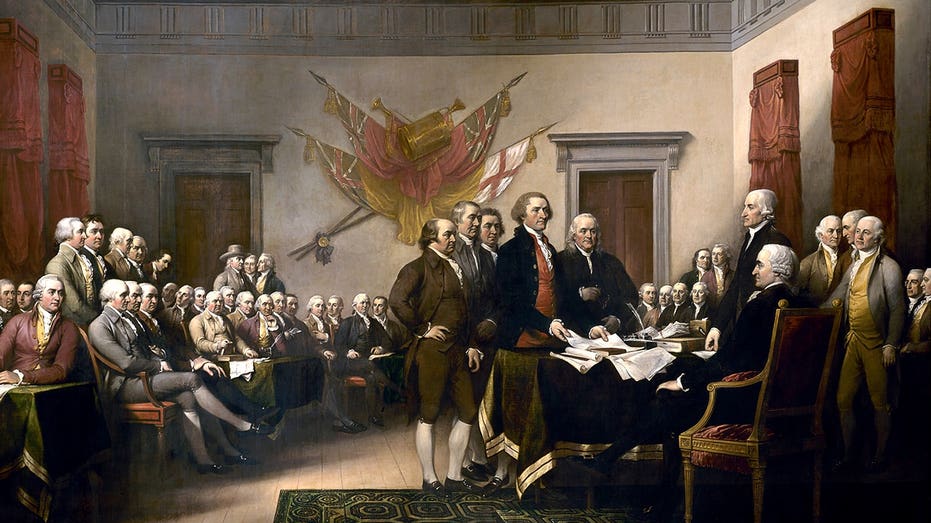


America's bond with Israel traces back to Puritan settlers who modeled their covenant on Hebrew Scripture, predating the nation's founding by centuries.
The bond between America and the Jewish people did not begin with the creation of the modern State of Israel. It predates even the founding of our great country 250 years ago. This relationship has never been simply diplomatic. It is covenantal.
Long before there was a United States, there was a people learning to govern themselves by the principles God gave at Sinai.
The Puritan settlers read that story not as ancient history but as their own unfolding plot. In 1630, their leader John Winthrop preached a sermon, "A Model of Christian Charity," closing with the word of Moses to the Children of Israel who were about to enter the Promised Land, urging his followers "to love the Lord our God, and to love one another, to walk in his ways and to keep his Commandments and his Ordinance and his laws, and the articles of our Covenant with him."
LIBERTY AND UNITY: WHAT AMERICA’S 250TH ANNIVERSARY ASKS OF US TODAY
The Mayflower Compact was understood to be a covenant, not a contract, because its signers understood that a contract is transactional while a covenant is consensual and is based upon freedom and personal responsibility.
Scholar Os Guinness documents the source of the American Revolution not in the libraries of Greece or the common law of England, but the Jewish idea of a people who choose, freely and morally, to be bound to one another and to God. In his book "America Agonistes," he writes, "America’s debt to the Jews is deepest when it comes to the Hebrew contribution to the founding genius of American freedom."
Our founders repeatedly expressed admiration for the Jewish contribution to civilization. John Adams wrote, "The Hebrews have done more to civilize men than any other nation…. and have influenced the affairs of mankind more and more happily than any other nation, ancient or modern."
Indeed, Adams was actually a Zionist. In correspondence, he declared, "I really wish the Jews again in Judea an independent nation."
EXCLUSIVE: MEET THE MAN ISRAEL CHOSE TO BE ITS FIRST-EVER AMBASSADOR TO THE CHRISTIAN WORLD
Walter Russell Mead’s "The Arc of a Covenant" explains that the pro-Israel conviction in America was never primarily a Jewish conviction. It was a Protestant one.
In 1891, evangelical minister William E. Blackstone presented a petition to President Benjamin Harrison calling for the restoration of Palestine to the Jewish people, "According to God’s distribution of nations it is their home—an inalienable possession." Signatories included J.P. Morgan, John D. Rockefeller, the chief justice of the United States, members of Congress, governors, mayors, and other officials, publishers, educators and clergymen.
Mead’s exhaustive argument is that long-held habits and cultural predispositions rooted in America’s identification with the Hebrew Scriptures have shaped U.S. policy toward Israel far more than any organization or president.
SIGN UP FOR ANTISEMITISM EXPOSED NEWSLETTER
CLICK HERE FOR MORE FOX NEWS OPINION
In the modern era, since the Jewish people re-established their sovereignty in their own War of Independence, America’s relationship with Israel has been moored in shared interests and values. Their founding document is suffused with the same moral DNA as the American Declaration of 1776, the conviction that certain inalienable rights exist prior to government, are not granted by any king but instead are rooted in a higher authority than any legislature or army.
The U.S.–Israel relationship does not begin with the intelligence-sharing, the joint military exercises, or the innovation Israel produces in water, medicine, and cybersecurity, though all of that matters enormously. It begins with our two nations, born out of the same audacious idea that people can covenant themselves to liberty and to law under God.
This relationship is not merely strategic but is, in the deepest sense, a mirror. When America looks at Israel, at its tenacity, its survival against odds that have crushed far stronger empires, its insistence on being a democracy in a neighborhood that offers none, America sees a semblance of its own worthwhile struggle.
This is what motivated me to found the U.S. Israel Education Association 15 years ago, to educate American leaders about this essential collaboration, to strengthen it and to reap its benefits for our country well into the future.
At 250, America does not necessarily need more allies, but it does need to remember and appreciate its origins and covenantal heritage. American and Israel both sprouted from the pages of the Jewish Bible and share a common script that reflects our identity and impacts our view of the world. That is why our alliance with Israel runs deep and will endure even the strongest forces that oppose it.
The post America and Israel: A covenant, not a contract appeared first on FOX News Media