









El Salvador Tourism Hits 3.2 Million Visitors as Land Borders Capture 63% of International Arrivals
-
Travel, Weather
-
-
8 mins
-
Travel and Tour World
-
Angana Dutta
-


El Salvador has welcomed more than 3.2 million international visitors through August 2026, but the biggest story lies in how they are arriving. Land borders account for 63% of international entries, highlighting the powerful role of regional travel as the Central American destination expands its tourism economy.
El Salvador’s tourism sector recorded 3.2 million international visitors in the first eight months of 2026, representing a strong growth of 22% over 2025. According to the Ministry of Tourism, of the international visitors for 2026, 63% used land transport and 37% used air transport. The biggest markets for El Salvador were Guatemala, the United States and Honduras. Traditionally, aviation has played a major role in international tourism in El Salvador, but the latest data shows that tourism is largely land-based. Also, the data shows that there is increasing regional and international tourism in the area, which is largely directed to El Salvador, and improved regional infrastructural investments. (Canal 12)
El Salvador passes 3.2 million international visitors
El Salvador recorded 3,241,583 international visitors from January through August 2026, according to figures attributed to the Ministry of Tourism. That represented growth of 22% compared with the same eight months of 2025. (Diario El Salvador)
The August results extend a strong first half. By June, El Salvador had already received about 2.5 million international visitors, equivalent to roughly 59.5% of the government’s initial full-year target of 4.2 million. (El Mundo)
The definition matters. Government visitor totals include overnight tourists as well as excursionists who enter the country but leave without an overnight stay. That distinction should be maintained when comparing the figures with international tourist-arrival datasets. (El Mundo)
Land borders capture 63% of international arrivals
The most striking feature of the latest data is not simply the number of visitors. It is how they are entering El Salvador.
Ministry figures reported in September show that 63% of international visitors arrived through land borders, while 37% arrived by air. (Canal 12)
That gives the country’s tourism expansion a strong regional dimension. El Salvador shares borders with Guatemala and Honduras, both of which are among its largest visitor markets.
| January-August 2026 indicator | Latest reported figure |
|---|---|
| International visitors | 3.2 million+ |
| Year-on-year visitor growth | 22% |
| Guatemala share | 41% |
| United States share | 27% |
| Honduras share | 19% |
| Arrivals by land | 63% |
| Arrivals by air | 37% |
Source: Ministry of Tourism figures reported in September 2026. (Canal 12)
The numbers show why roads and border crossings are important parts of the El Salvador tourism 2026 story. Air connectivity remains essential for long-haul markets, but regional land travel is delivering the majority of international entries.
Guatemala has become the largest visitor market
The latest figures also show a major change in El Salvador’s source-market structure.
Guatemala accounted for 41% of arrivals, ahead of the United States at 27% and Honduras at 19%. (Canal 12)
More detailed January-August figures put arrivals from Guatemala at 1,328,604, representing year-on-year growth of 44%. The United States supplied 881,842 visitors, with growth of just 0.4%. (Diario El Salvador)
That contrast helps explain the importance of the land-border figure. El Salvador’s growth is increasingly connected with regional Central American travel, rather than being dependent on expansion from a single long-haul source market.
For hotels, restaurants, attractions and tour operators, that visitor mix also creates different commercial requirements. Regional travellers arriving by road may have different booking windows, trip lengths, transport needs and destination patterns from passengers arriving on international flights.
Tourism receipts rise alongside visitor numbers
The growth is generating substantial tourism receipts.
Tourism Minister Morena Valdez said in September that El Salvador generated more than US$2.8 billion in tourism foreign-exchange earnings between January and August 2026, an increase of more than 10%. International visitor numbers over the same period increased 22%. (El Salvador)
That difference is worth noting. Visitor growth and tourism-receipt growth do not necessarily move at identical rates because expenditure varies by market, length of stay and type of traveller.
The government has increasingly positioned tourism as an economic development sector linked with accommodation, restaurants, transport, infrastructure, entrepreneurship and foreign investment.
Surf City remains central to tourism investment
The government’s Surf City programme remains one of the most visible parts of that strategy.
The Ministry of Tourism describes Surf City as an integrated programme combining tourism infrastructure, basic services, human-resource training, road connectivity and destination development. Its first phase included improvements around Puerto de La Libertad and El Tunco. (MITUR)
El Salvador Ministry of Tourism — Surf City programme
The strategy has expanded eastwards through Surf City II. The Ministry lists a US$106 million tourism recovery and expansion programme financed by the Inter-American Development Bank, covering projects including tourist corridors, cycle routes, ecological waterfront areas, viewpoints, sanitation, wastewater treatment, skills development and support for tourism microenterprises. (MITUR)
The latest procurement activity shows the programme is still advancing in 2026. MITUR has sought design work for basic infrastructure intended to improve the visitor experience in priority Surf City I and II destinations. (MITUR)
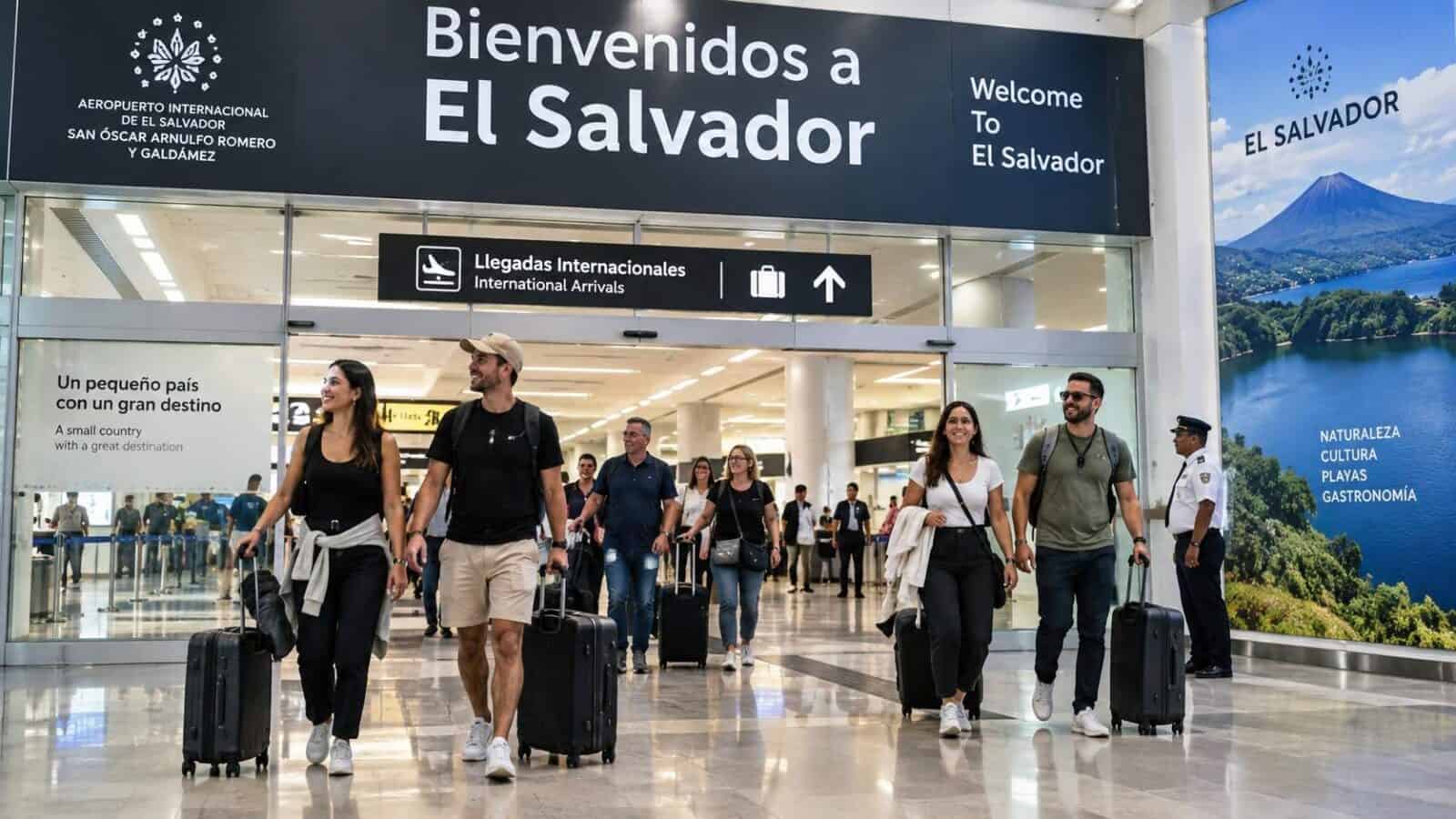
El Salvador is also preparing for more air travellers
The dominance of El Salvador land arrivals does not mean aviation is becoming less important.
El Salvador International Airport handled more than 5.2 million passengers in 2025, including arrivals, departures and connecting passengers. During the opening weeks of 2026, traffic increased 7% year on year. (Cepa)
In June, authorities inaugurated a new arrivals terminal. Its baggage system expanded from four to 12 belts, raising processing capacity from 6,000 to 16,500 bags per hour. The project also added car-rental spaces, passenger pick-up areas and upgraded customs facilities. (Cepa)
CEPA is pursuing a wider second stage of airport modernisation. The programme includes additional passenger gates, aircraft positions, taxiway expansion, parking and other infrastructure, with an IDB-backed financing package of US$195 million supporting modernisation. (Cepa)
CEPA — El Salvador International Airport modernisation
The investment creates an interesting balance. El Salvador currently receives most international visitors by land, while simultaneously building additional capacity for future air demand.
Pacific Airport could broaden tourism development eastwards
A second aviation project could have longer-term implications for eastern El Salvador.
The first phase of the International Airport of the Pacific carries an announced investment of US$386 million. CEPA says the initial development is designed for around 300,000 passengers annually and approximately 2,000 flight operations. (Cepa)
The project is intended to improve connectivity in eastern El Salvador and support tourism and economic development around the region. That geographic objective also complements the investment being directed into Surf City II.
For travellers, the significance is the gradual diversification of gateways and tourism infrastructure beyond the country’s established western and central visitor corridors.
Hotels and local businesses face a bigger tourism market
The rise in international arrivals expands the potential customer base for accommodation providers, restaurants, guides, transport companies and attractions.
MITUR is also working on an investment strategy specifically for the hotel-tourism sector in western and central El Salvador. A consultancy process launched in July 2026 seeks to develop an integrated strategy for attracting foreign direct investment into the sector. (MITUR)
Other tourism programmes have a direct local-business component. Surf City II includes non-reimbursable support for tourism microenterprises and human-capital development, while its gastronomic programme is designed to connect local producers with tourism businesses. (MITUR)
This makes the visitor numbers more than a national arrivals statistic. The commercial question is how effectively that traffic spreads through local economies and into tourism businesses outside the busiest destinations.
Sustainability is built into the eastern tourism programme
Growth also creates pressure on destinations, infrastructure and natural resources.
The Ministry’s Surf City II programme therefore includes environmental sustainability, climate mitigation and adaptation, risk management, wastewater infrastructure and destination conservation among its components. (MITUR)
That is particularly relevant along coastal areas where tourism investment, local communities and environmentally sensitive destinations intersect.
The programme also includes public infrastructure and skills development. MITUR says the US$106 million eastern tourism initiative is intended to produce social, economic and environmental benefits while connecting local people with employment and markets. (MITUR)
What the figures mean for travellers
Visitors planning an El Salvador trip now have two very different access patterns.
Travellers from Guatemala and Honduras can use regional land connections, which currently account for most international entries. Long-haul visitors continue to depend primarily on air access through El Salvador International Airport.
Within the country, tourism development is spreading across Surf City, San Salvador, eastern beaches, natural areas, archaeological attractions and cultural destinations.
Travellers should still check current immigration requirements, border-opening information, transport conditions and official destination guidance before travelling. Entry requirements can vary according to nationality and mode of arrival.
2026 target remains in focus
The government initially set a target of around 4.2 million international visitors for 2026. By August, the country had already passed 3.2 million. (El Salvador)
Officials have continued to connect future tourism expansion with public infrastructure, workforce development, private investment and international connectivity.
The latest MITUR procurement programme also shows continued spending on destination promotion, tourism events and investment attraction during the remainder of 2026. (MITUR)
The official plans therefore point towards continued capacity-building rather than relying solely on rising visitor numbers.
FAQs
What is driving El Salvador’s international visitor growth in 2026?
Regional demand is a major factor. Guatemala represented 41% of international visitors through August, followed by the United States at 27% and Honduras at 19%. Land borders handled 63% of international arrivals, underlining the importance of cross-border Central American travel. (Canal 12)
Is flying the main way international visitors enter El Salvador?
No. Ministry of Tourism figures reported for January-August 2026 show 63% entered by land and 37% by air. However, El Salvador is simultaneously expanding airport infrastructure and international connectivity. (Canal 12)
Which destinations should international travellers know about?
Surf City and San Salvador’s historic centre remain prominent parts of the country’s tourism offer, alongside volcanoes, lakes, national parks, archaeological sites, cultural destinations and eastern coastal areas. Travellers should use official tourism and immigration information when planning routes and checking entry requirements. (El Salvador)
Conclusion
El Salvador’s tourism industry is rapidly developing. From January to August of 2026, the country welcomed 3,239,125 international visitors. Of that number, 63% entered El Salvador via land crossings. The largest number of land border visitors (84%) came from neighboring Guatemala. A flourishing visitor economy is made possible by the ongoing public and private sector investments to enhance El Salvador’s air and land connections, tourism infrastructure, and services. As these new airport, land, and sea connections bring more international visitors to El Salvador, the tourism industry of El Salvador will continue to grow and develop. Over the next few years, visitors will be able to fly directly to El Salvador from more international destinations. As more visitors arrive by air, El Salvador will develop its tourism industry to reinforce and strengthen connections to other international destinations to create a tourism circuit.(Canal 12)
The post El Salvador Tourism Hits 3.2 Million Visitors as Land Borders Capture 63% of International Arrivals appeared first on Travel and Tour World